
By Karan Mehra — SEO Consultant / Head of SEO | 16 October 2026
A new budget control is useful only when the team knows which problem it is meant to solve. If your account has poor lead qualification, an unreliable purchase event or an offer that does not convert, a new channel setting can move the symptoms without fixing the business.
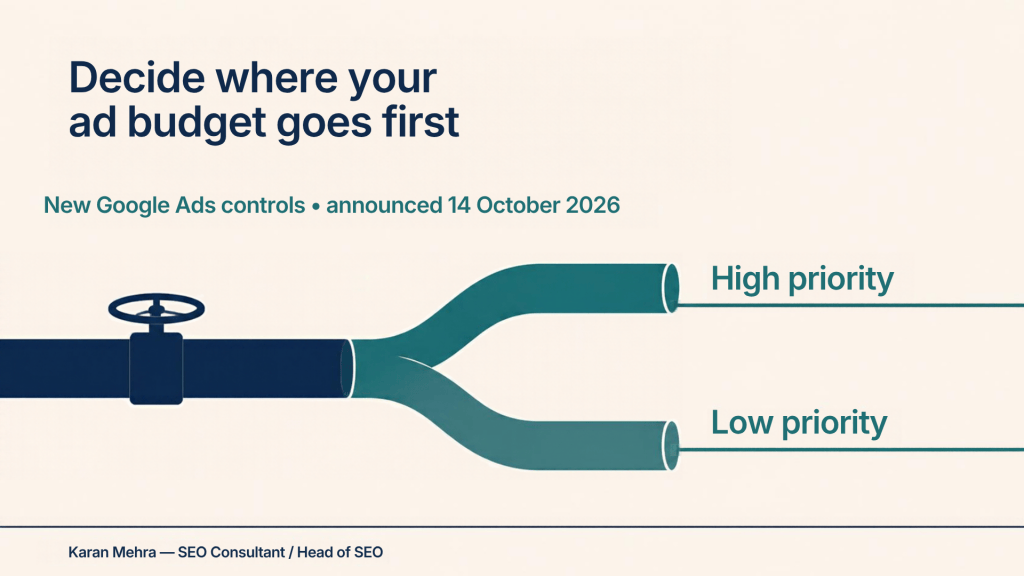
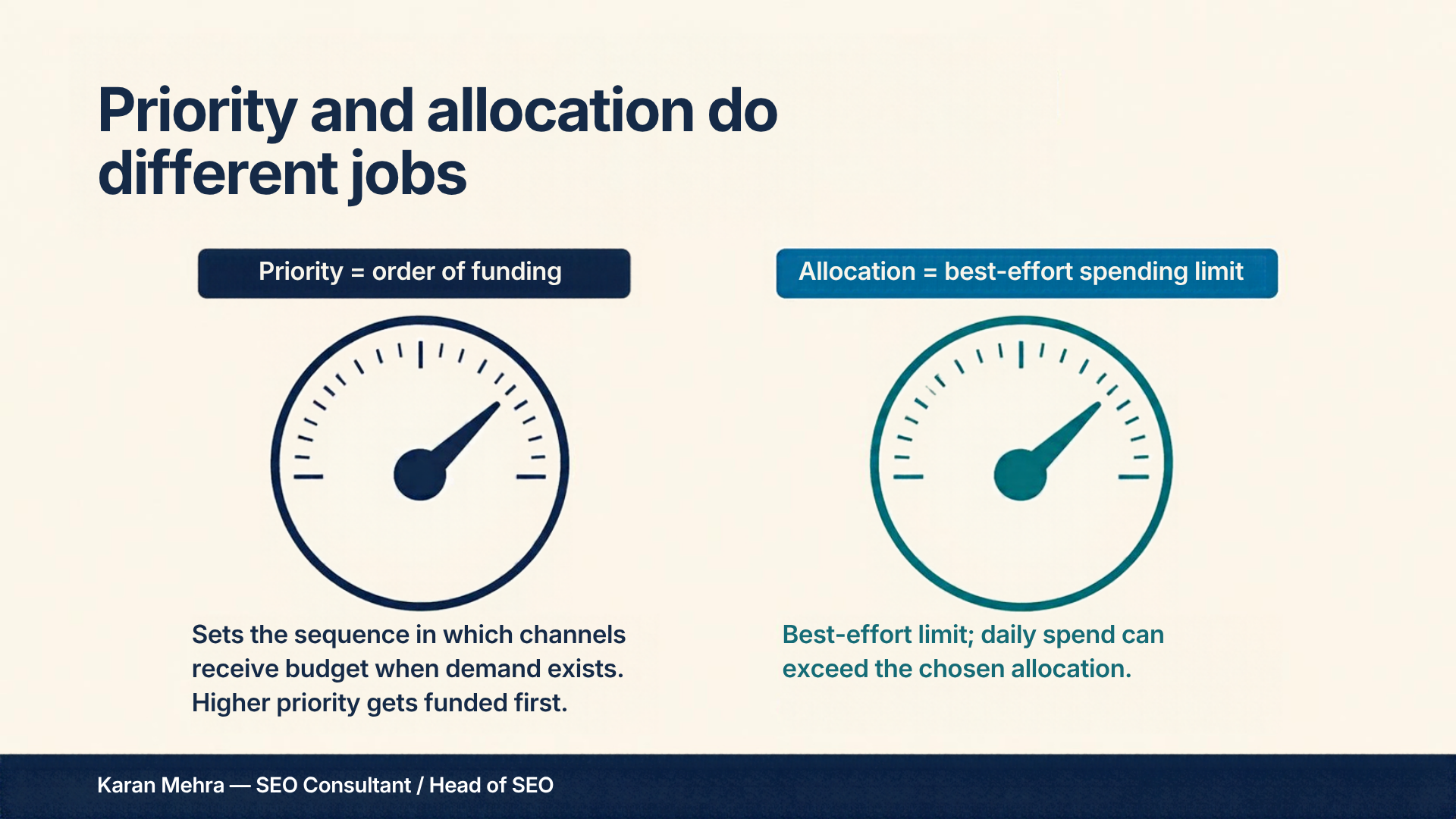
Google’s 14 October announcement introduces optional channel prioritization and budget allocation controls across Search, Shopping, Performance Max and Demand Gen during a progressive rollout. High and low tiers influence funding order; a lower-priority allocation can limit network exposure. This is a meaningful operational change for advertisers who previously treated network participation as a binary choice. Read Google’s announcement.
The right response is a documented account audit. This article separates the confirmed product mechanics from a proposed implementation process. The examples are hypothetical planning exercises, not client case studies or forecasts.
What the documentation actually establishes
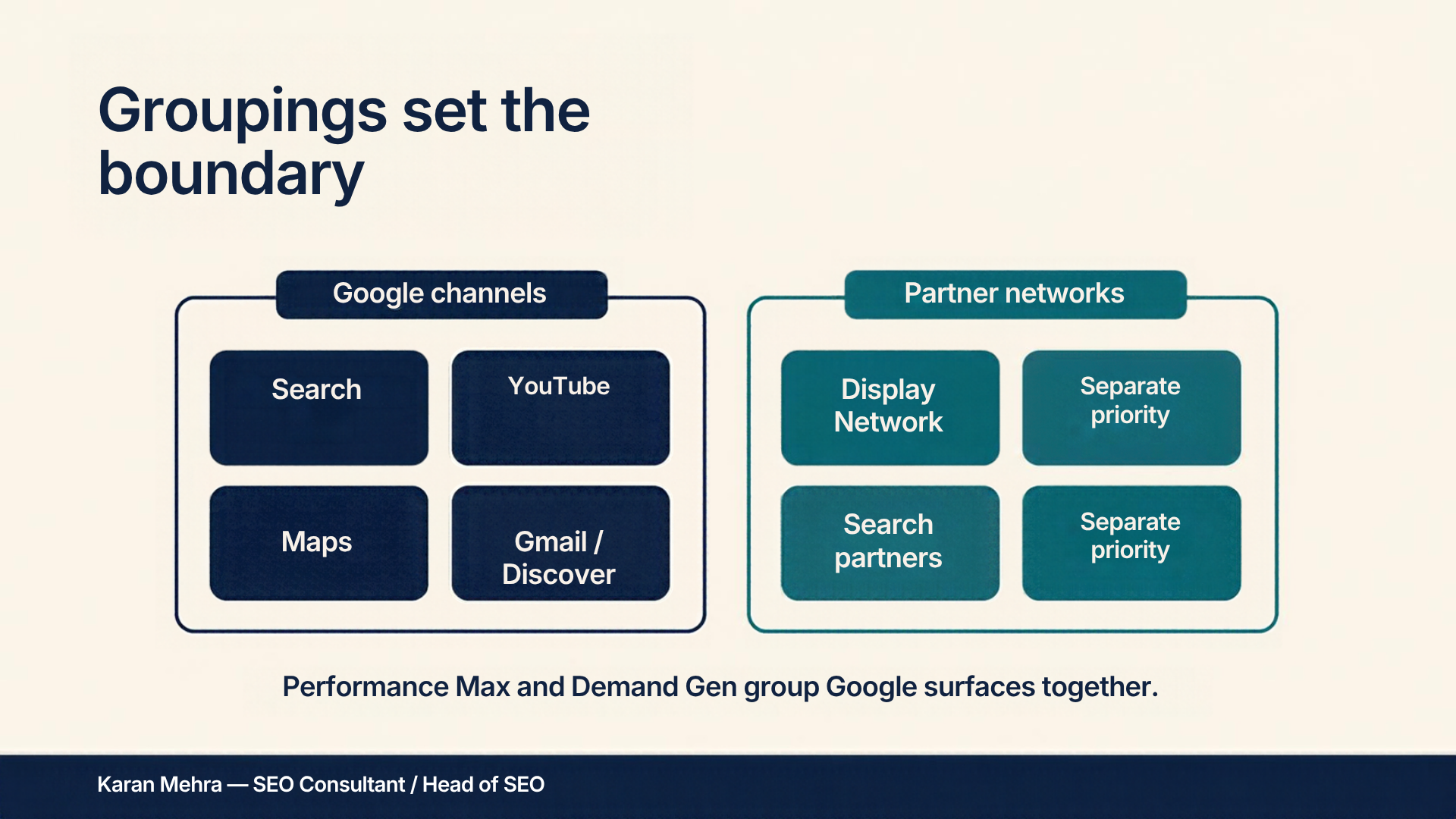
Google’s Help Center states that rollout begins progressively on 15 October. Demand Gen supports prioritization, but not budget allocation. Performance Max and Demand Gen combine Google’s own surfaces into a Google channels group. Allocation uses average daily budget, not actual spend, and is best effort. For unconstrained target-based campaigns, priority alone generally will not redistribute spend. Settings can inherit from account defaults or be overridden for a campaign/shared budget. February 2027 brings a Search Display Expansion migration; Google’s preservation option is GDN at Low priority with 50% allocation. Consult the Google’s product announcement before making changes.
Those qualifications matter more than the headline. A product announcement tells you what is becoming possible. Your account evidence determines whether using it is sensible.
For an audit that connects media settings with lead quality and landing pages, PRM Digital’s paid advertising service can help establish a commercially useful baseline.
Start with the business question, not the settings panel
Write a decision statement
Before touching the account, complete this sentence: “We want to understand whether changing ______ improves ______ without damaging ______.” A service business might test whether reducing exposure to a weak source improves sales-accepted lead cost without reducing weekly booked appointments. A retailer might prioritize contribution after returns rather than the volume of attributed purchases.
Avoid vague objectives such as “improve traffic quality.” They invite selective reporting. Decide how a lead becomes qualified, which team owns that decision and when the outcome is recorded. For ecommerce, agree whether the evaluation includes cancellations, shipping subsidies and refunded orders. These are proposed business measurement practices, not new Google requirements.
Separate a channel problem from a conversion problem
Ask the sales team to review a sample of recent enquiries before blaming inventory. Duplicate forms, recruitment enquiries and out-of-area customers may need different remedies. A low-quality form submission could reflect a confusing landing page rather than a distribution problem. Conversely, excellent engagement does not make an enquiry commercially useful.
Build a short diagnosis log with four fields: symptom, supporting evidence, alternative explanation and proposed remedy. If the alternative explanation remains plausible, do not present a channel adjustment as a proven solution.
Want a second opinion on the decision statement? Contact Karan on WhatsApp at +91 98036 18014 with the objective and the business outcome you measure.
Build a baseline the next reviewer can reproduce
Capture configuration and performance together
Save the current settings, campaign objective, bidding approach, conversion definitions and available inventory breakdown. Record the review window and why it was chosen. A period containing a promotion, a stock outage or a site failure is not interchangeable with normal trading.
Use a consistent evidence table: date range; campaign; relevant network or grouping; spend; primary outcomes; qualified outcomes; revenue or contribution where available; major confounders. Keep “not available” explicit. Do not silently turn unavailable channel data into zero performance.
The baseline should also identify owners. Media operations can change the setting, analytics can verify event integrity, sales can judge qualification and finance can assess economics. One person may cover several responsibilities in a small business; the responsibilities still need to exist.
Decide what would change your mind
Write a review rule before launch. For example: “We will retain the change only if qualified outcome cost improves while total qualified volume remains commercially acceptable.” Add a maximum tolerable loss and an escalation owner. Choose values from the business’s economics and historical variability; there is no defensible universal threshold for every account.
If the campaign produces few outcomes, a short observation window may answer nothing. Record that limitation before the change. Waiting for mature evidence is better than promoting a noisy daily fluctuation into a strategic conclusion.
A worked planning example: a local service business
Consider a hypothetical installation company spending ₹2,000 per day. Its reporting shows many forms, but sales only accepts enquiries within a defined service area. The business first reconciles form records with sales outcomes and discovers that several campaigns use inconsistent qualification labels.
The immediate task is to repair that labeling. After establishing a comparable baseline, the team identifies one eligible campaign as a candidate for a limited network test. It records the current configuration, chooses one setting change and leaves the offer, creative and landing page stable during the initial comparison.
A hypothetical 10% planning allocation on ₹2,000 corresponds to ₹200. That arithmetic illustrates how the reference budget affects the planning envelope; it does not predict what the campaign will spend or earn. The team monitors actual delivery and mature qualified enquiries rather than treating a percentage as an accounting guarantee.
If reported lead cost rises but booked-job cost falls, the change may still serve the business. If cheap leads increase while sales acceptance falls, a better-looking platform metric may conceal weaker economics. The purpose of the test is to learn which of these outcomes occurred.
For help mapping campaign outcomes to sales records, send your measurement question to +91 98036 18014 on WhatsApp. Do not send customer-level personal data in an initial enquiry.
Use a controlled rollout instead of an account-wide reaction
1. Confirm access and scope
Inspect the actual client account and eligible campaign. Record what controls are present and the effective source of each setting. If the feature is absent, log the account as pending availability. Do not rebuild the campaign simply to imitate a control that has not arrived.
2. Choose a reversible pilot
Select an account segment with reliable measurement, a clear commercial problem and enough activity to evaluate. Preserve the previous configuration and a rollback owner. Avoid starting with the highest-risk seasonal campaign if the team cannot monitor it closely.
3. Change one decision at a time
Keep a dated change log. A simultaneous bid target change, creative refresh, landing page launch and inventory adjustment may be operationally necessary, but it prevents a clean explanation of the result. If multiple changes cannot be separated, describe the evaluation as a combined intervention rather than an isolated channel test.
4. Review delivery, quality and economics
A practical review has three layers. First, did the account deliver as expected? Second, did the outcomes meet the agreed quality definition? Third, did the business gain profitable demand or merely rearrange attribution? These questions require different evidence and should not be collapsed into a single dashboard score.
Use platform reports alongside CRM or order records. A before-and-after comparison is useful operational evidence, but it does not by itself prove incremental causality. Promotions, competitors, seasonality and changes in customer demand can affect both periods.
The agency governance issue: defaults can become policy
An account default is a business policy once it affects several campaigns. Treat it with the same care as a shared measurement definition. Record who proposed the rule, why it exists, which campaigns are exceptions and when it should be reviewed.
For agencies, put the effective setting source in the handover document. A new operator should be able to answer whether a campaign follows the default or an exception without reconstructing weeks of conversations. During reviews, check that an old exception still serves a current objective.
This is also where full-service coordination matters. Media buying, website experience, creative, analytics and CRM follow-up influence the same customer journey. PRM Digital’s paid advertising team can connect those responsibilities into one review process rather than optimize a network setting in isolation.
Prepare for the migration without copying a percentage blindly
Put the February 2027 checkpoint into the account’s operating plan. Inventory affected campaigns, capture their present behavior and assign a reviewer before the seasonal workload makes documentation harder. The preservation option described above should be evaluated in its stated context, not promoted as a universal recommendation.
A useful migration worksheet includes: campaign owner, present configuration, intended commercial behavior, proposed replacement, measurement owner, review date and rollback approach. Where an automated upgrade and a voluntary change overlap, record the effective date clearly so later analysis is interpretable.
The business question remains the same: does the resulting configuration support the demand you actually want to buy? A setting can match yesterday’s configuration and still deserve a fresh commercial review.
A practical first-week action plan
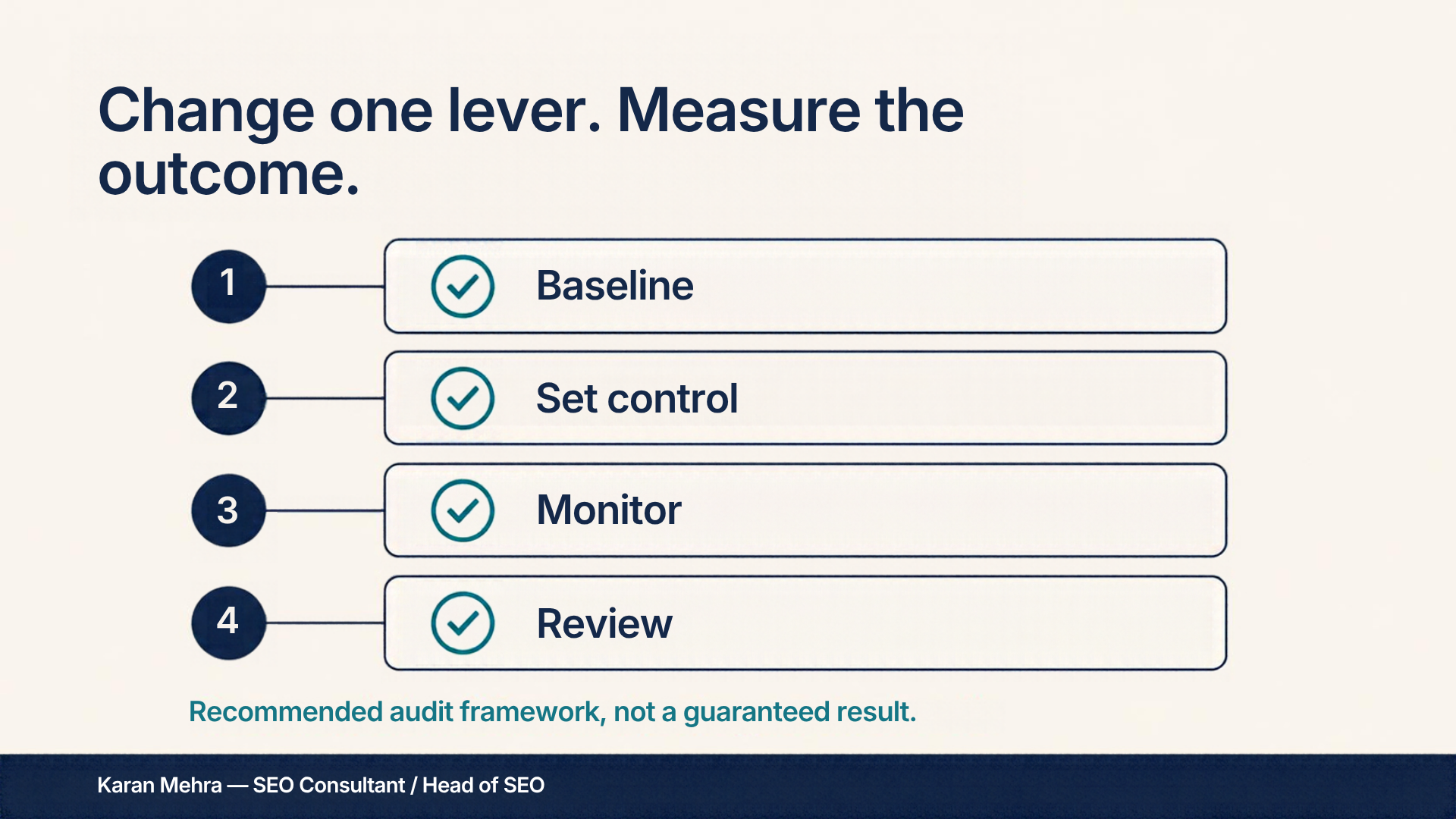
On day one, inventory availability and current settings. Next, reconcile the primary conversion with a real business outcome. Then choose one pilot, define the review rule and capture the baseline. Launch only after a named owner can explain the hypothesis and monitor delivery.
Use the first week to validate execution and identify obvious measurement faults. Let conversion lag and outcome volume determine when a performance judgment is credible. A seven-day checklist is an operating cadence, not a claim that every test concludes in seven days.
If your team needs help turning the audit into a pilot, contact Karan on WhatsApp at +91 98036 18014 with the campaign type and the outcome you want to improve.
Frequently asked questions
Should I change every campaign when the controls appear?
No. Start from an identified problem and a reviewable hypothesis. A new option is not evidence that the existing configuration is failing.
Which metric should decide the pilot?
Choose a business outcome the team can verify: sales-accepted enquiries, fulfilled orders or contribution, for example. Pair efficiency with volume so an apparent improvement does not hide unacceptable lost demand.
Can a before-and-after comparison prove the change worked?
It can inform an operating decision, but it cannot automatically separate the setting’s effect from market changes. Record confounders and use stronger experimental design when the commercial decision warrants it.
What if the pilot produces too few conversions?
Preserve the observations and mark the result inconclusive. Reconsider the observation period, measurement quality and pilot scope rather than inventing certainty from sparse data.
What should the handover contain?
The hypothesis, baseline, effective settings, change date, responsible owner, outcome definitions, review rule and rollback configuration. The next operator should be able to reproduce the reasoning.
Editorial note: Product facts checked against Google’s announcement and Help Center on 16 October 2026. Frameworks and hypothetical examples are Karan Mehra’s proposed implementation guidance. No performance uplift is promised.


Leave a Reply