
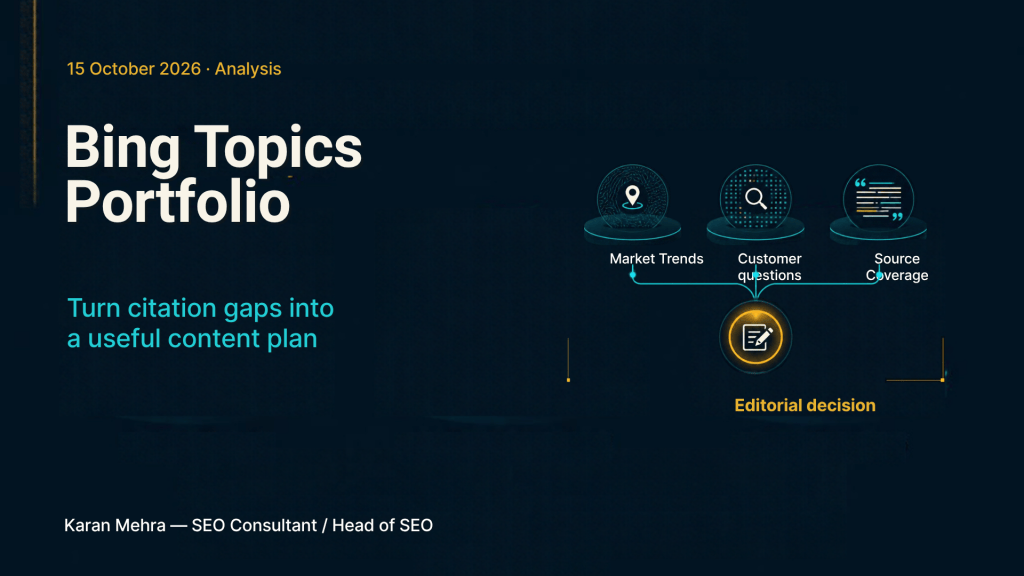
A competitor appears in an AI answer and your company does not. The easy response is to commission another article. The better response is to ask whether the missing citation represents a useful business opportunity—and whether a new page is the right way to address it.
Bing Topics Portfolio makes that decision more visible. But a report can identify a pattern without telling you which work deserves your next week of writing, design and expert review. That judgment still belongs to the business.
This guide explains the documented product change briefly, then proposes a practical editorial process. The decision gates, examples and 30-day pilot are our recommendations. They are not Microsoft ranking rules or a promise that a content update will earn citations.
What Bing Topics Portfolio adds
Microsoft’s 13 October 2026 announcement describes Topics Portfolio as a beta view in Bing Webmaster Tools’ AI Performance report. It groups a site’s grounding-query presence into themes. Topic Size estimates citations across sites; Sites Cited and Queries describe the approximate breadth of sources and queries. Opportunity queries identify gaps where other sites appear, with citation volumes presented as ranges.
Microsoft cautions that classification can be imperfect, branded opportunities may appear and insufficient activity can limit visibility of the feature. Treat the figures as planning signals, not exact demand forecasts. Check AI Performance for the relevant verified site and record whether the view is actually available.
A citation is not a visit or a qualified lead
The underlying AI Performance launch documentation concerns citations across supported Microsoft AI experiences and selected partners. Grounding-query data represents a sample of citation activity. Page-level citations do not establish a page’s rank, authority or position in an answer.
That distinction matters when reporting to a founder or finance team. A visibility signal belongs in the report, but it cannot stand in for enquiries, accepted opportunities or revenue. Maintain a separate chain of evidence from content work to observable audience responses and business actions.
Microsoft had already discussed Intents, Topics, Citation Share and Compare in its June 2026 preview update. The October announcement is an evolution in the reporting experience, not the beginning of AI-search measurement.
For help connecting AI visibility work with a commercially useful content strategy, explore PRM Digital’s SEO and AI Search Optimization service.
Create a decision record before a content brief
An opportunity list should enter a review queue, not automatically become a publishing queue. Create a short record for each candidate so the team can explain why it accepted, deferred or rejected the work.
Record the audience problem in ordinary language. Then identify the relevant service, product or business objective; the existing page that comes closest to answering it; the evidence your organisation can contribute; the likely production effort; and the person responsible for reviewing accuracy.
Keep the original report wording alongside your interpretation. If a query is ambiguous, write down the uncertainty rather than treating the label as a complete account of customer intent. A short phrase may describe a research task, a brand comparison or a problem your company does not serve.
The output should be a decision a colleague can challenge. “Large opportunity” is not enough. “This fits our implementation buyers, our existing guide omits a recurring question, and our delivery lead can contribute a tested example” gives the editor something concrete to assess.
Apply three gates to every candidate
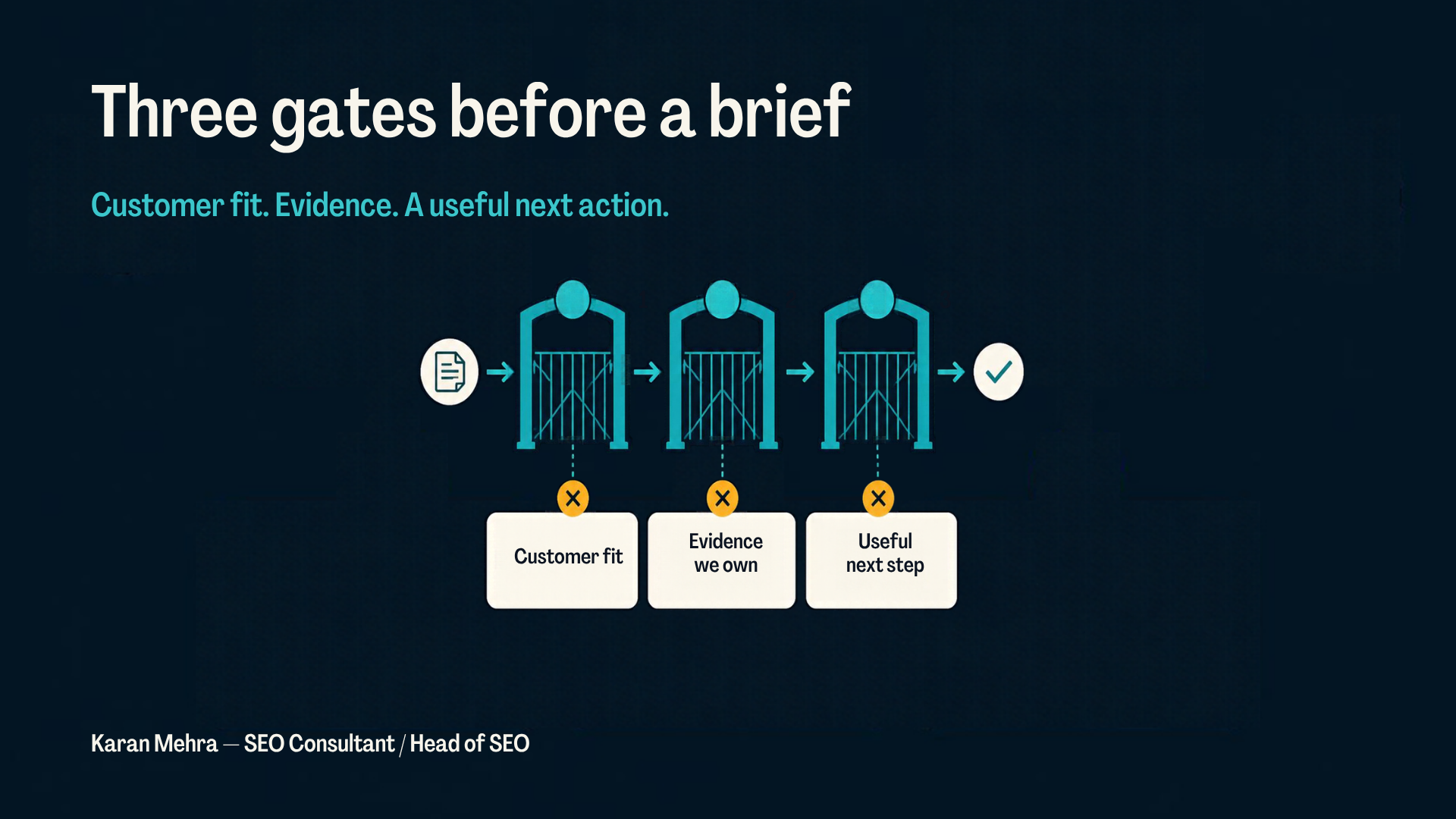
Our recommended gates are customer fit, evidence and a useful next action. They are editorial safeguards, not a proprietary scoring model. Passing all three does not establish search demand or guarantee distribution; it establishes a stronger reason to do the work.
Gate 1: does the problem fit a customer we can serve?
Ask who would benefit from the answer and how that person relates to your business. A software provider might have genuine expertise in implementation planning but little reason to publish about every consumer technology trend in the same broad theme.
Exclude opportunities that would attract the wrong geography, service need or buying situation unless awareness is the explicit objective. Evaluate branded comparisons case by case. You can publish an accurate, fair comparison where there is a legitimate customer need; do not force a competitor’s navigational query into an unrelated sales page.
Document the intended value even for informational content. The value may be helping a future buyer ask better questions, supporting an existing customer or reducing uncertainty before a consultation. It does not need to be an immediate sale.
Gate 2: what useful evidence can we contribute?
Decide what the organisation knows that a generic summary would miss. Useful evidence could include a documented workflow, a carefully explained calculation, a first-hand demonstration or an expert-reviewed comparison with clear limitations.
Give that evidence an owner and a collection task. If the proposed article depends on a case study, confirm permission and the underlying records before promising results. If no reliable evidence is available, narrow the claim, commission the research or defer the idea.
Originality should be visible in the answer, not merely in a new headline or colour palette. A useful diagram can explain a process, but it cannot replace missing expertise.
Gate 3: what should the reader be able to do next?
The next step must follow naturally from the problem. A person comparing implementation options may need a checklist; someone diagnosing a configuration issue may need a troubleshooting sequence. A consultation invitation fits when the problem requires tailored assessment.
Avoid giving a post several competing jobs. Decide what successful comprehension or action looks like, then design the explanation and destination around it. Ensure the destination is relevant, works correctly and makes the next step clear.
Want help reviewing a shortlist of AI-search content opportunities? WhatsApp Karan Mehra at +91 98036 18014.
Refresh, consolidate, create—or defer
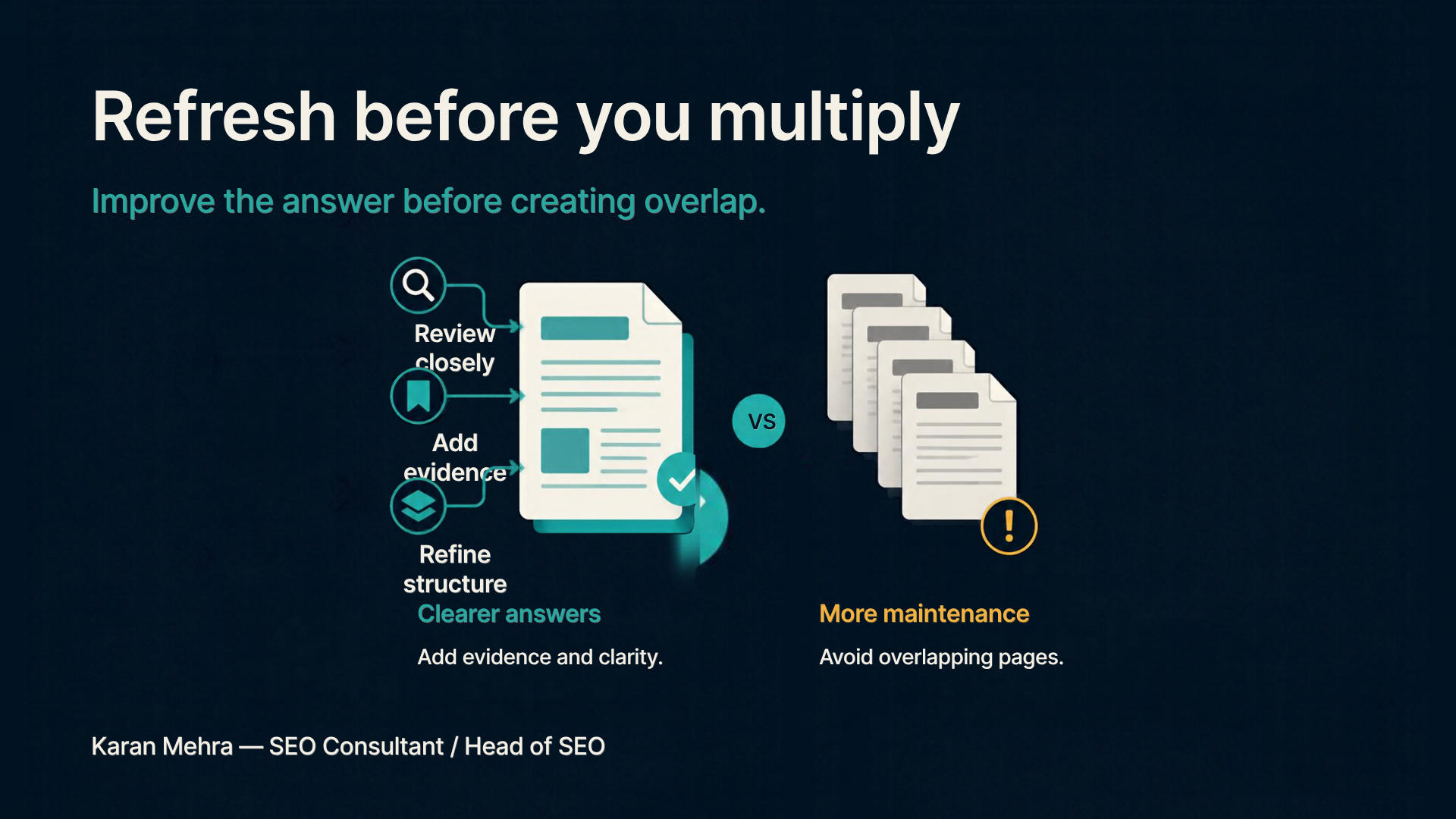
Passing the gates does not automatically justify another URL. Start by finding the page that should own the customer question.
Refresh when an existing page already serves the same need but lacks evidence, a clear explanation or current details. Preserve its useful material, add the missing answer and make the change easy for a returning reader to understand.
Consolidate when several pages repeat the same purpose and no longer have a clear role. Review their value and dependencies before deciding how to combine them. Consolidation can require redirects, internal-link changes and technical checks; do not delete content merely because it appears similar in a spreadsheet.
Create when the customer task is distinct and the organisation can support a substantial independent answer. Define how the new page relates to the existing service, product and learning resources before writing it.
Defer when fit is weak, evidence is missing or a higher-priority improvement would serve customers better. Record the condition that would justify reconsideration. A deliberate rejection is a useful outcome of an audit.
Two illustrative decisions
The following examples are hypothetical. They show how the review process works and make no claim about client results, citation gains or search volumes.
B2B software: improve the migration guide
A software company identifies a relevant question about moving customer records between systems. It already has a migration guide, but the guide discusses features rather than the practical risks a project manager faces.
The customer-fit gate passes because the business serves those implementation teams. The evidence gate passes only if the delivery team can document how it handles field mapping, duplicate records, validation and rollback planning. The next action might be downloading a preparation checklist or requesting an assessment.
The editorial decision is to refresh the existing guide with an expert-reviewed workflow and a clear statement of assumptions. Creating five overlapping articles would add production and maintenance work without necessarily improving the answer.
Local service: answer the booking question clearly
A home-services business considers a question about what is included in a site inspection. Its service page gives a broad promise but does not explain the actual appointment.
The team can document who attends, what information the customer should prepare, what the inspection covers and which charges or conditions need clarification. It should publish only the practices it actually follows, with the operations owner checking the wording.
The right outcome may be a more useful service page rather than a separate blog post. A relevant next step is booking the assessment, with clear expectations before the customer submits an enquiry.
Run a 30-day pilot with one accountable owner
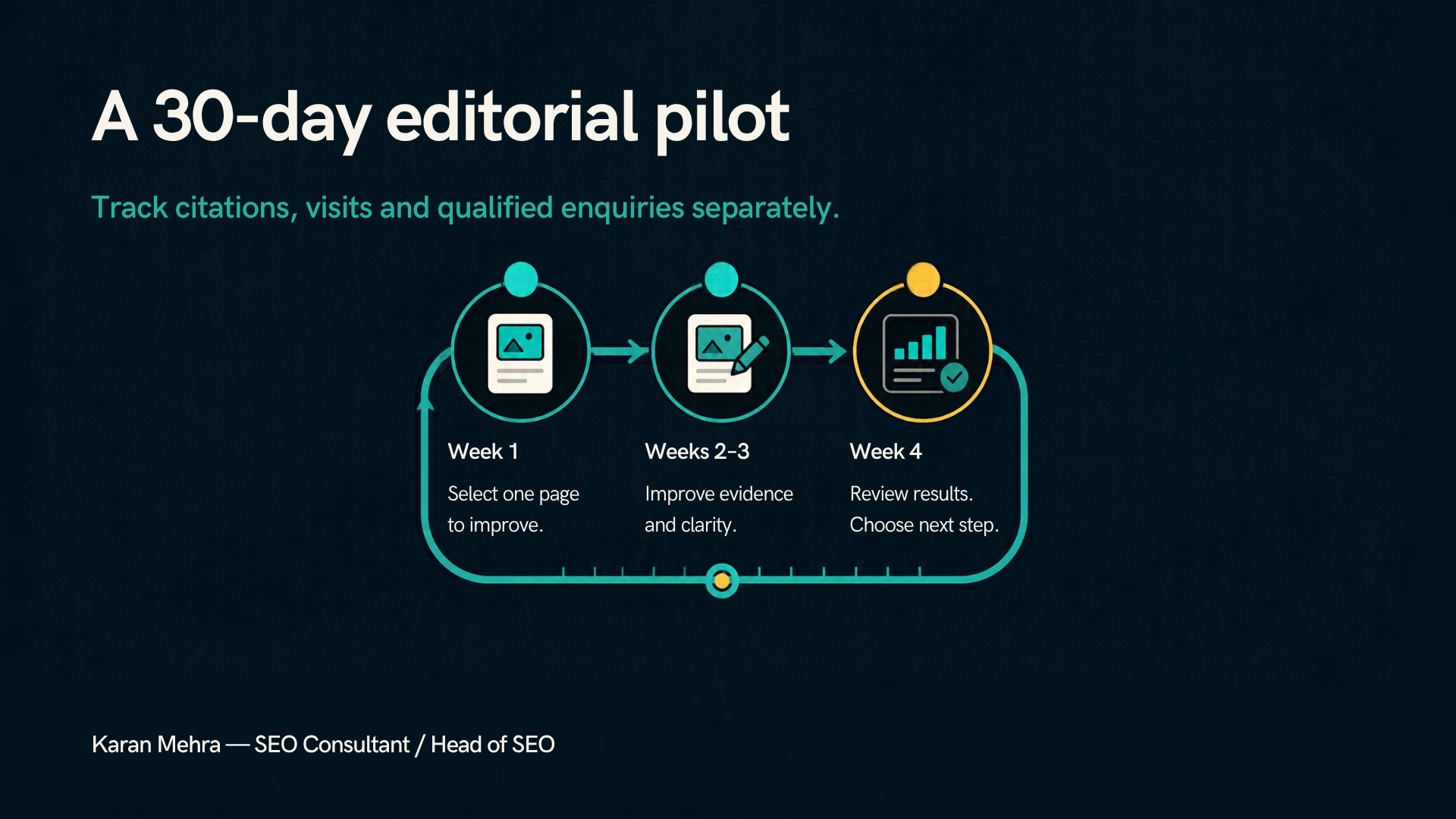
Use a small pilot to learn how well the editorial process works before expanding production. Thirty days is a proposed management window, not a promised period for AI-search improvement. Some outcomes will require longer observation.
Week 1: select and baseline
Choose one commercially relevant theme and a small set of candidate questions. Record the report view, period and the pages under review. Apply the gates, identify the strongest existing page and document why each candidate was selected or deferred.
Capture the available baseline from analytics and business records. Define an enquiry consistently—for example, a real request for a service you provide in a location you serve. Separate accepted opportunities from spam, irrelevant requests and repeat contacts.
Weeks 2–3: produce and verify
Assign an editor, a subject expert and a publishing owner, even if one person holds several roles. Collect the promised evidence, draft the improvement and check that examples, claims and sources support the answer.
Review headings, tables, illustrations and internal links as part of one explanation. Confirm that the intended page is accessible and that the update does not create an obvious duplicate purpose elsewhere. Keep a dated change log showing what changed and why.
Publish only after checking the actual rendered page. A saved draft with missing images is not a completed content improvement. Re-read the live links and inspect desktop and mobile views.
Week 4: review and choose the next action
Review what was shipped, whether the content answers the brief and what early responses are observable. Keep the date windows comparable. Do not compare a newly updated page’s first few days with a mature page’s entire quarter and call the difference an effect.
Choose whether to retain the treatment, improve a specific weakness or wait for a longer observation period. Keep broader site changes, promotions and unusual traffic events in the record so they do not disappear from the explanation.
For help setting the pilot scope and reviewing the evidence, WhatsApp +91 98036 18014.
Report three separate outcomes
Visibility: record available citation signals with the relevant source and reporting period. Preserve the distinction between the site’s own observations and broader contextual measures. Do not combine metrics with different definitions into one apparently precise performance score.
Audience response: review observable visits, engagement with the improved answer and meaningful questions. Referrer-based analytics cannot describe every exposure or every journey, so mark the unobservable portion instead of estimating it as fact.
Commercial response: record relevant enquiries, booked assessments or accepted opportunities using the business’s definitions. Add sales feedback where it helps distinguish curiosity from a real need.
Review these outcomes together without claiming a causal chain you have not established. A page can receive useful visits without a sale, or influence a buyer who later arrives through another channel. A citation change can also coincide with unrelated content, product or platform changes.
An executive update should therefore explain the work delivered, the evidence observed, the uncertainty and the next decision. A small report that informs a decision is more useful than a large dashboard that mixes incompatible numbers.
If your team needs a repeatable process across content, technical SEO and AI visibility, work with PRM Digital’s SEO and AI Search Optimization team.
Frequently asked questions
Should every opportunity become a new page?
No. Apply the customer, evidence and next-action gates, then choose whether to refresh, consolidate, create or defer. The objective is a better answer with a clear purpose.
Is a large topic automatically the best investment?
No. Commercial fit, credible evidence, production effort and the usefulness of the existing page all matter. A large-looking opportunity can still be the wrong task for your organisation.
Can this process guarantee citations or leads?
No. It creates a more defensible editorial decision and a clearer measurement record. Distribution and customer actions remain outcomes to observe, not promises to attach to a content brief.
What if the beta view is unavailable?
Record that limitation. The review gates can still be applied to customer questions, existing content and available reporting, but do not present that substitute process as data retrieved from Topics Portfolio.
What should the content owner bring to the first review?
Bring one proposed customer question, the closest existing page, the evidence you can add, the person who will review it and a useful next step for the reader. That is enough to start a concrete prioritisation conversation.
Discuss your next content audit with Karan Mehra on WhatsApp: +91 98036 18014.
Written by Karan Mehra. Reviewed 15 October 2026. Product descriptions are sourced from Microsoft. The decision framework, examples and pilot are original recommendations; no client results or guaranteed outcomes are claimed.


Leave a Reply