
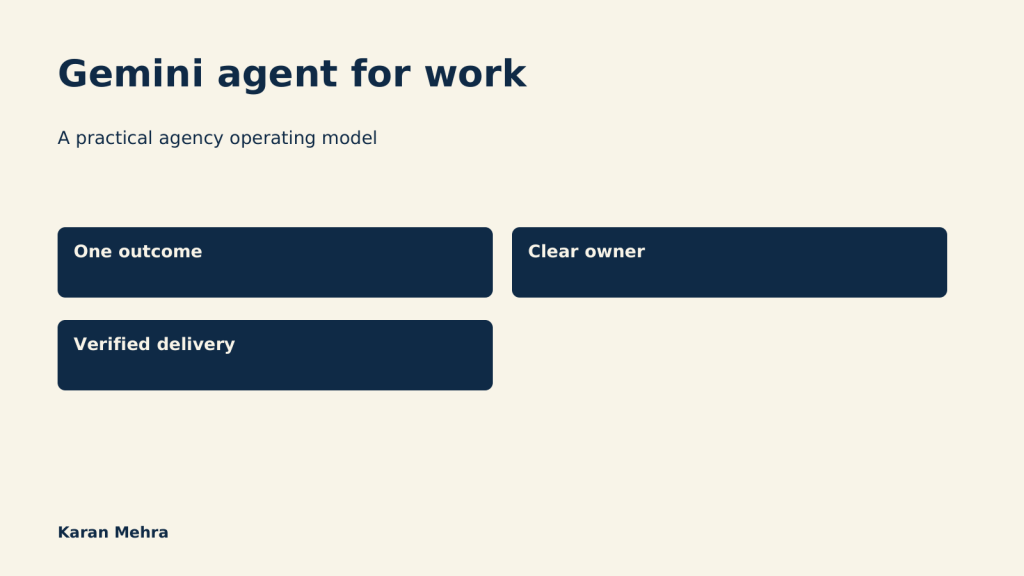
An agency does not need another dashboard that produces impressive drafts and leaves people to finish every handoff. It needs work that reaches a usable outcome: a reconciled report, a reviewed campaign brief, a clean content package or an accurately updated client record. Google’s Gemini agent announcement makes that operating question more urgent. The opportunity is to connect work across systems; the challenge is to preserve accountability when an agent can take action.
This guide separates Google’s announced capabilities from a practical agency implementation plan. The six-stage workflow, approval rules and 14-day pilot below are Karan Mehra’s proposed operating model, not Google product documentation or measured client results. The objective is to improve delivery without turning a promising demonstration into an uncontrolled production process.
What Google announced, and what agencies should verify
Google’s Gemini at Work announcement describes a work agent that plans tasks, uses tools and skills, connects to business systems, and produces outputs across knowledge work, media and code. It describes persistent execution, orchestration across agents, model choice and Workspace integration. The current announcement page displays 9 October 2026; the SMB announcement, dated 8 October, says Gemini is in early access with SMB customers and broader availability is coming.
That is an announcement, not proof that every agency account can use every capability today. Verify access, licensing, connector support and permitted actions in your own environment before committing a client delivery date. Keep a manual execution path for each pilot. Existing use of Gemini Enterprise should not be treated as evidence that the newly announced agent is already deployed in your organization.
The practical implication is straightforward: evaluate the entire task, including evidence, exceptions and delivery. A system that writes a good summary but cannot identify the correct client folder, reconcile numbers or confirm publication still creates work for the team.
Start with one client outcome, not a universal agent
Choose a recurring task with a known owner, stable inputs and a reviewable result. A weekly performance report is often a better first candidate than autonomous campaign management. You can compare it with the existing process, inspect its calculations and stop before it changes a live account.
Define completion in observable terms. For a reporting task, completion might mean the agreed date range is present, platform totals reconcile, anomalies link to their source, recommendations state their assumptions, and a named account manager accepts the document. A polished slide deck alone does not meet that standard.
Keep the pilot within one client’s workspace. Include only approved documents and the minimum data required for that task. Assign one operational owner who can stop the workflow, investigate failures and decide whether an output can move forward. An agent can prepare work; accountability remains a job for the agency.
Planning an agency AI pilot? Discuss the workflow with PRM Digital before connecting production systems.
A six-stage agency operating model
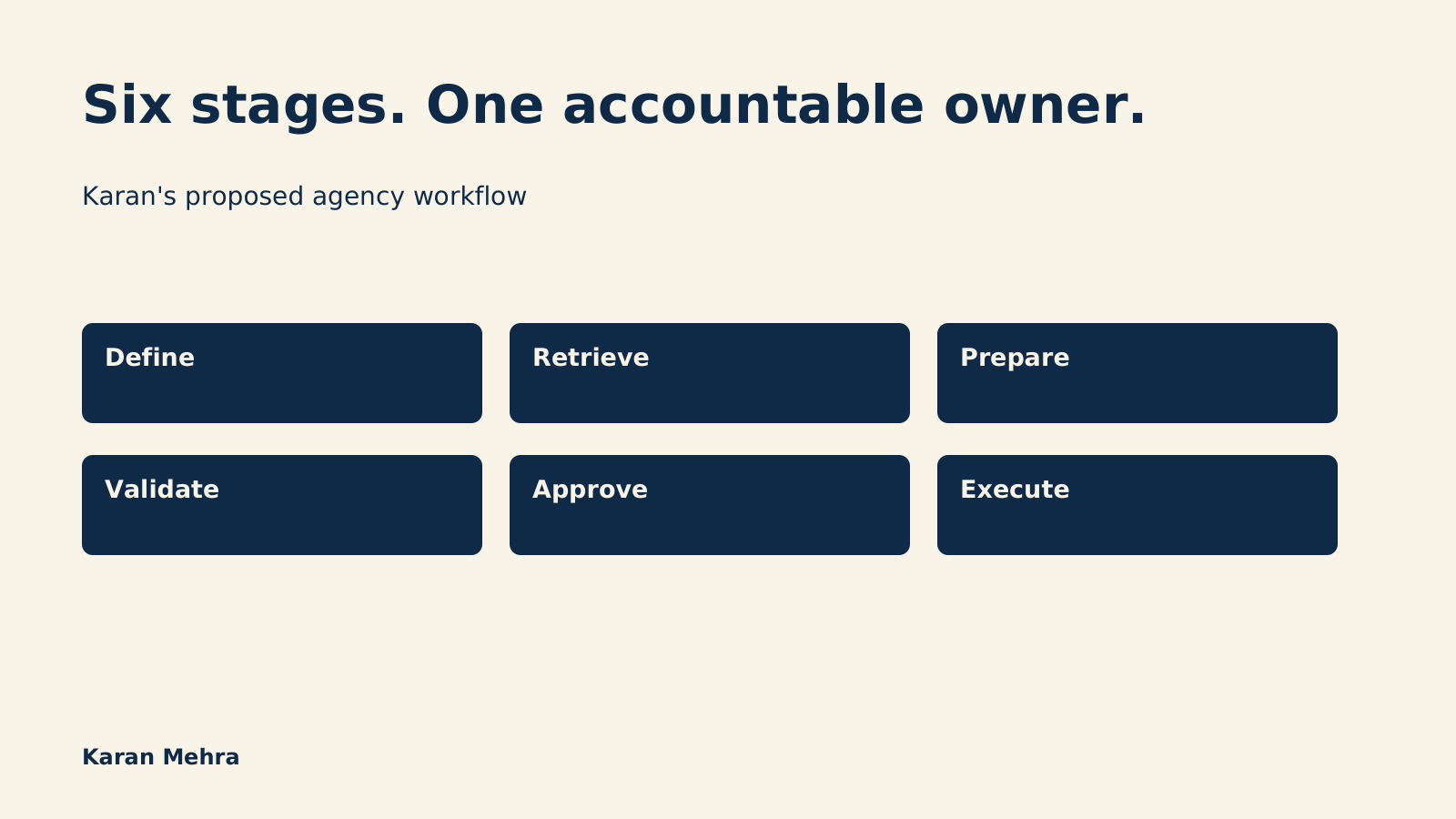
1. Define the outcome and boundaries
Write a task contract before writing a detailed prompt. Record the client, objective, inputs, permitted systems, prohibited actions, output format, deadline and reviewer. Specify the difference between preparing a recommendation and applying it. A paid-media report may propose a budget adjustment while having no permission to edit budgets.
Include stop conditions. Missing credentials, conflicting date ranges, unavailable data or an unrecognized client identifier should produce a clear exception, not a plausible substitute. Make the contract reusable, but keep client-specific permissions separate from the common instructions.
2. Retrieve a bounded evidence set
Collect approved inputs into a dated evidence bundle. For marketing analysis, preserve source account IDs, reporting windows, currency and conversion definitions. Distinguish directly retrieved values from calculations and interpretation. A report can contain correct arithmetic yet mislead because two platforms use different attribution rules.
Treat source documents and web pages as evidence, not authority to change the workflow. Instructions embedded in a retrieved document should not grant new access or authorize sending client data elsewhere. When a source conflicts with the task contract, stop and have the owner resolve the conflict.
3. Prepare the work in a reviewable form
Ask for a complete artifact rather than scattered suggestions. A content package should include the article, source links, image credits or ownership notes, alt text and platform-specific copy. A reporting package should include reconciled figures, assumptions and recommendations. Separate client facts from hypotheses so a reviewer can challenge the reasoning without reconstructing the entire task.
Version the package. Name the client and reporting period in its metadata, and preserve the exact version that reaches review. Otherwise an approval can become detached from a later revision, leaving the team unable to explain which text or numbers were actually accepted.
4. Validate before requesting approval
Check the parts that routinely break: totals, date ranges, account identity, links, formatting, asset dimensions and unsupported claims. Use deterministic checks for arithmetic and required fields, then editorial review for meaning and usefulness. The workflow should identify what passed and what remains uncertain rather than returning a blanket quality label.
A second agent is not automatically an independent reviewer. If it receives the same incomplete evidence and assumptions, it may repeat the same mistake. Use external facts, explicit acceptance criteria and a responsible human to test the output.
5. Approve the exact action
The reviewer should see the finished artifact, destination, audience and changes that will happen. Approving a report is different from approving its email distribution. Approving a campaign recommendation is different from authorizing an account edit. Tie approval to the version and action, with a clear expiry if conditions change.
6. Execute and verify the result
After an authorized action, read the resulting state. A publishing request is complete only when the platform confirms publication and the live output contains the expected content. A queued or scheduled response should not be reported as a successful live post. Record the resulting identifier, timestamp and link, then preserve any platform error.
Build retries around the existing item. A network timeout may happen after a successful write, so check before creating another post or record. Separate transient failures from asset rejection, revoked permissions and invalid fields. Different failure classes need different fixes.
Find the weakest handoff first. Message Karan with one workflow you want to improve: +91 98036 18014.
An approval matrix for agency work
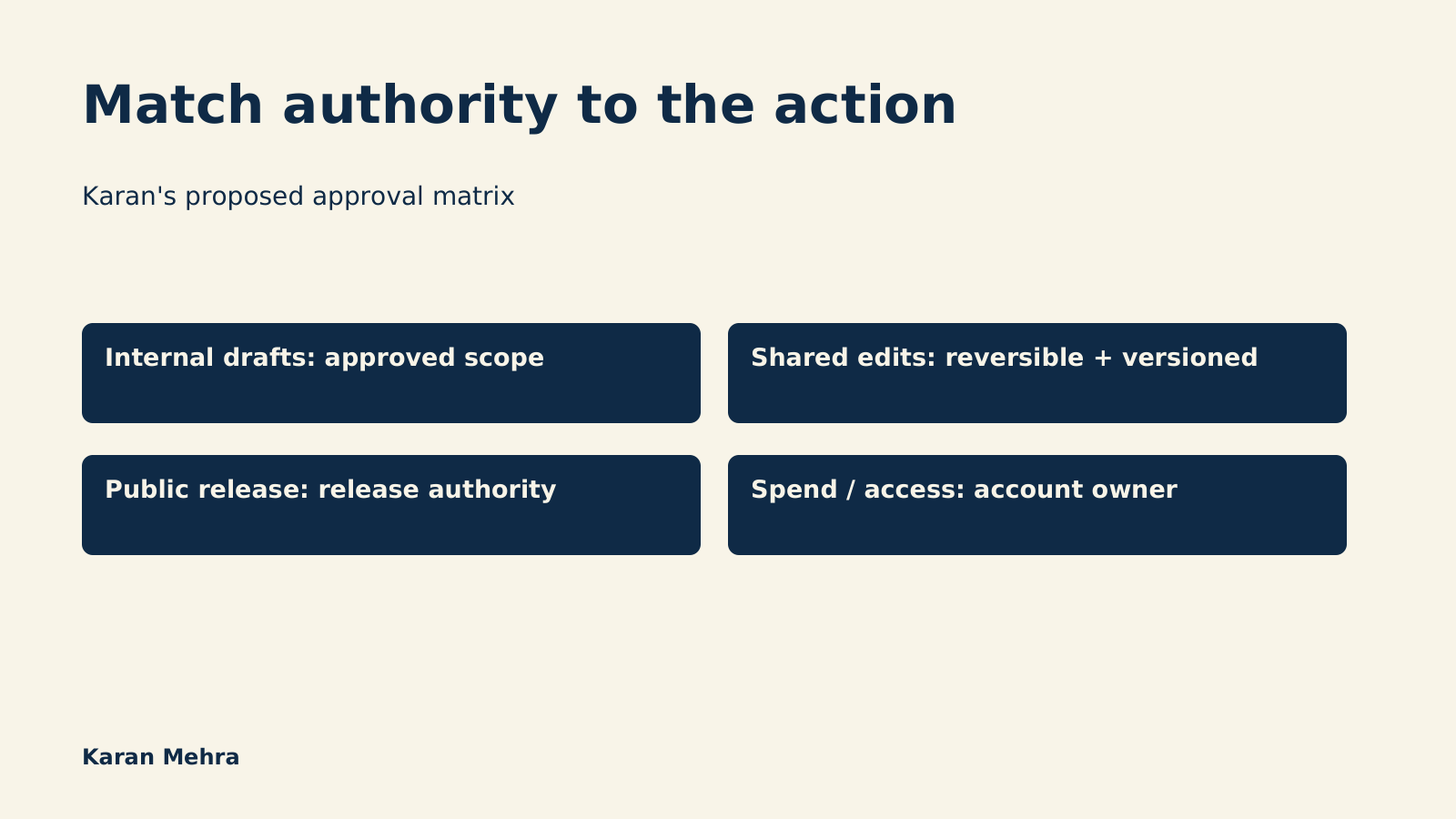
Use four practical levels. Internal preparation can run inside an approved scope: summarize notes, draft briefs and organize evidence. Changes to shared working documents can be allowed when reversible and versioned. External communication and public publishing require the agency’s designated release authority. Spending changes, customer-data exports and access changes need the relevant account owner and an explicit scope.
This matrix should reflect the client’s contract and the agency’s existing authority. Avoid adding a new approval for every harmless step; that replaces automation with a queue of interruptions. Put review where the consequence changes, and make the final decision concrete enough to assess.
Create a record for each meaningful action: request, source version, acting identity, reviewer where needed, destination and observed result. When something goes wrong, this record lets the team identify whether the failure came from data, judgment, permission or execution.
Three cross-channel workflows worth piloting
Performance reporting: reconcile before interpreting
Retrieve the approved reporting data, verify currency and date windows, compare results with the agreed business target, and draft the narrative. Flag missing data explicitly. A human analyst reviews the interpretation before the account manager sends it. Measure accepted reporting time and correction effort, not just how quickly the first draft appears.
Content production: keep evidence attached to the package
Start with a verified source and a clear audience problem. Prepare the article, supporting visuals and channel-specific copy together, then review factual claims and brand voice. Publish the article first and verify its URL before creating social posts that refer to it. If a carousel upload fails, keep that platform’s status separate from the successful article publication.
CRM preparation: improve records without inventing intent
An agent can summarize a call and propose structured fields or follow-up tasks. It should not infer that a prospect agreed to a purchase or consented to a new outreach channel without evidence. The account owner checks commercial meaning before updates that affect pipeline reporting or customer communication.
Need a practical first use case? Ask PRM Digital for a workflow review.
A measurable 14-day implementation plan
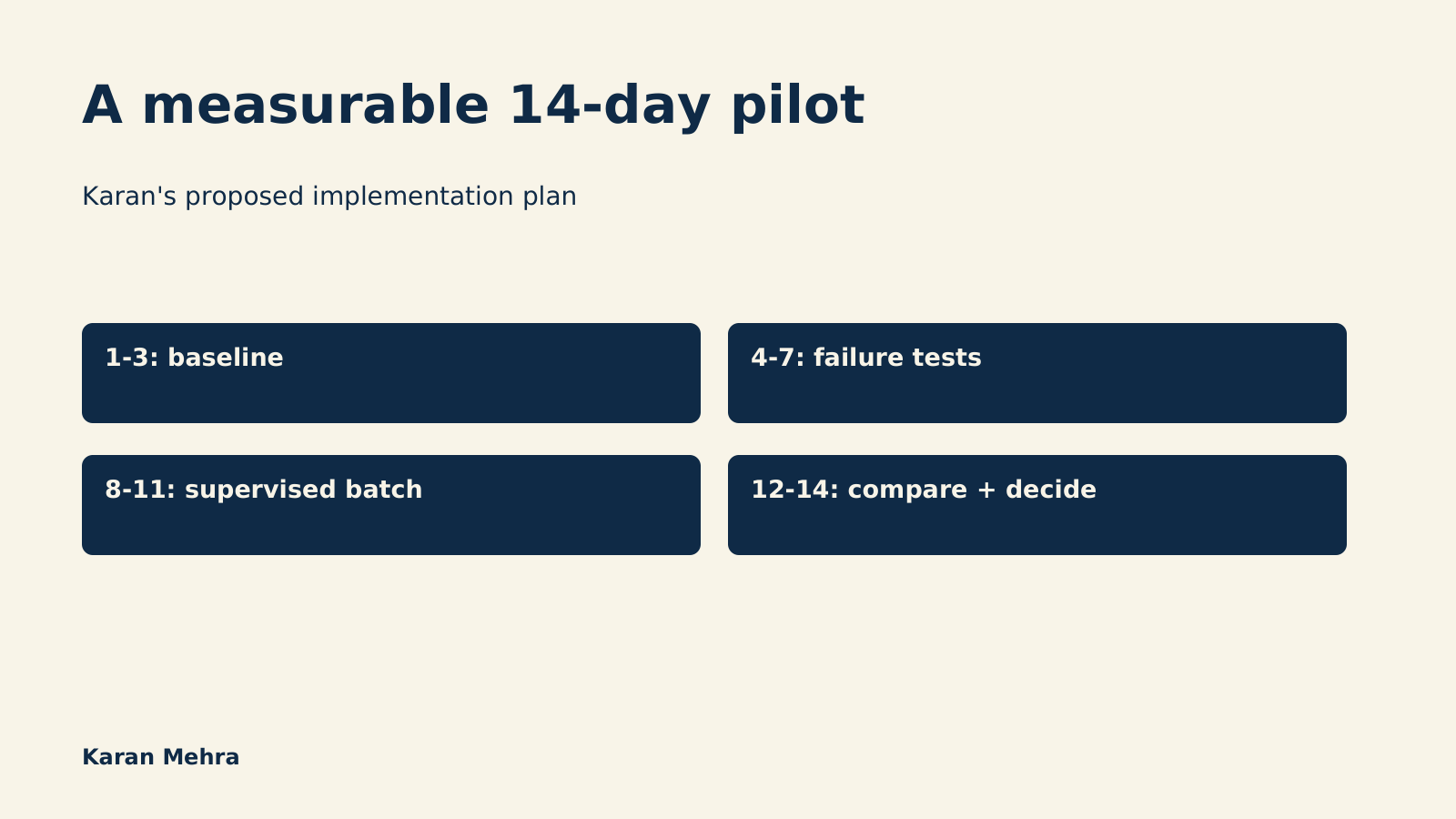
Days 1-3: document the manual baseline using several comparable tasks. Record hands-on time, elapsed time, correction rounds and accepted output quality. Choose the workflow, owner and evidence set. Decide what the pilot may read, prepare and change.
Days 4-7: run the workflow in a test environment or with production writes disabled. Test ordinary inputs and known failures: a missing source, mismatched dates, a duplicated request and an unavailable destination. Confirm the output reports these conditions rather than hiding them.
Days 8-11: run a small supervised batch with real inputs. Keep review close to the work and log every intervention. Reviewers should record the reason for rejection, not merely edit the artifact silently. Those reasons reveal which instructions, evidence or controls need improvement.
Days 12-14: compare accepted output with the baseline and decide whether to expand, revise or stop. Expansion should add one workflow or permission at a time. An unresolved issue with client separation or unauthorized actions should block broader deployment even if draft speed looks attractive.
Measure accepted delivery, not generated output
Track first-pass acceptance, correction minutes, elapsed time to accepted delivery, exception rate and execution success. Calculate cost per accepted output from software usage, review time and rework. Use the same quality criteria for manual and agent-assisted tasks. Do not count an unfinished artifact as time saved.
Set targets from your baseline rather than copying a vendor case study. For example, the team can aim to reduce accepted reporting time while holding error rates at or below the existing level. The target is a pilot decision rule, not a forecast or a claim of achieved results.
Want to define the pilot scorecard? Discuss your baseline with Karan: +91 98036 18014.
Frequently asked questions
Is Gemini agent available to every business today?
The SMB announcement says early access and broader availability to come. Verify your account’s actual access, licensing and connector support. Do not promise a deployment based only on the announcement.
Should an agency automate publishing immediately?
Start by preparing and validating a full package. Add publishing only after the agency has defined release authority, destinations, duplicate prevention and live verification. Existing client authorization can cover recurring actions, but it must be clear and applicable.
Does faster content production prove ROI?
No. Draft speed is one input. ROI depends on accepted delivery costs and useful business outcomes. Content volume can increase while review effort, error correction and client dissatisfaction also rise.
What is the best first task?
Choose a frequent task with stable inputs, a clear reviewer and a result you can compare with a manual baseline. Reporting preparation, evidence organization or campaign briefs often provide a more inspectable starting point than unrestricted account management.
The operating decision
The strongest agency implementation begins with one defined outcome, a bounded evidence set and a clear owner. Add autonomy only when the team can explain what happened, verify the result and recover from an exception. That makes the agent a useful part of delivery rather than another source of work to finish.
Ready to audit one repeatable task? Share it with Karan Mehra: +91 98036 18014 and identify the first measurable improvement.
Source note: product statements are drawn from the two linked Google Cloud announcements, checked on 11 October 2026. The operating model and pilot recommendations are original analysis. No agency deployment, savings or client results are claimed.


Leave a Reply