
By Karan Mehra | Digital Marketing Strategy | 10 October 2026
Meta’s new advertising AI tools promise to compress campaign planning, creative production and optimization. That does not remove the need for human approval; it makes the approval process more important. Budget mistakes are financial mistakes. Audience mistakes can weaken lead quality. Creative mistakes can put brand claims in front of thousands of customers before anyone reviews them.
At Advertising Week New York on October 6, Meta announced broader creative tooling, a more capable Ads Manager business assistant and several new agentic features in testing. Reporting from Social Media Today and MediaPost captured the shift toward conversational campaign workflows. My interpretation: the best agency response is not blind automation. It is a fast, measurable, permission-based operating model.
This practical guide separates feature availability from future testing and provides a 14-day implementation framework for founders, marketing heads, in-house media buyers and agencies. It is intentionally about Meta Ads and operational control—not another Google ranking update.
Need a review of your Meta campaigns before you delegate work to an AI assistant? Contact me on WhatsApp: +91 98036 18014
What changed in Meta Ads in October 2026?
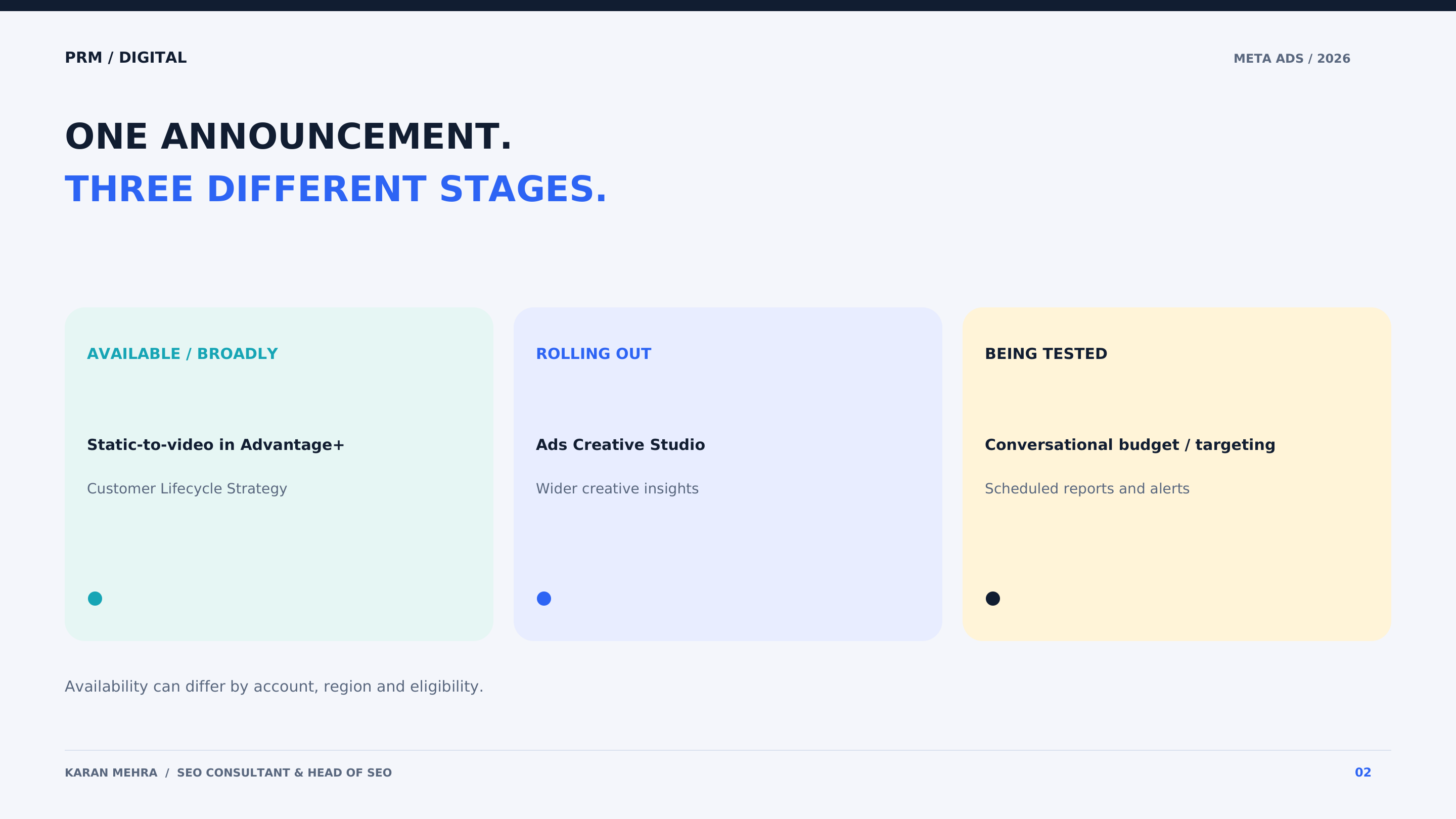
Meta’s original Advertising Week announcement describes several connected updates. The important editorial distinction is availability: some tools are broadly available, some are rolling out to more advertisers, and others are explicitly under test. A press release listing features together does not make them equally accessible in every account or geography.
Ads Creative Studio expands to more advertisers
Meta says its Ads Creative Studio is reaching more advertisers after early testing. The creative workspace helps marketers understand which assets perform for different objectives and use those signals in subsequent work. An agency still needs to form a real hypothesis: why would a new product demonstration, objection-handling concept or social-proof angle persuade a different type of customer? Generating ten near-identical captions does not count as ten meaningful experiments.
The AI business assistant gains deeper context and memory
Meta says its business assistant inside Ads Manager can bring creative insights into campaign recommendations and remember more of an advertiser’s previous tests, seasonality and stated goals. It is also testing the import of brand strategy, voice and guidance from tools teams already use. This is useful only if the source data is accurate and relevant. Yesterday’s creative winner may fail under a new offer or audience.
Conversational campaign edits and scheduled tasks remain in testing
Meta described tests of capabilities that can help create campaigns, generate creative, change targeting or modify budgets through conversation. It is also testing scheduled monitoring, summaries and reminders. Previews, permissions and approvals are part of Meta’s stated design. For larger agency workflows, the Meta Ads MCP server also supports agent-prepared drafts rather than silently publishing live changes. These are reported capabilities and tests, not a promise of universal autonomous account management today.
Customer lifecycle, audience discovery and video creative
Meta describes Customer Lifecycle Strategy as available to advertisers, helping acquisition campaigns distinguish new buyers from existing customers. AI-enabled audience discovery through natural-language descriptions is planned for Detailed Targeting later in 2026. Separately, converting static images into video through Advantage+ creative is broadly available; other video-generation and catalog workflows have their own eligibility and rollout stages. Agencies must inspect their own account interfaces and terms.
PRM Digital helps connect social advertising, creative testing and business reporting into a coherent growth program. Explore PRM Digital social media marketing →
Why Meta’s agentic shift creates a new budget-control problem
Traditional campaign management usually has visible handoffs: a strategist identifies a problem, a media buyer drafts a change, someone approves material risk, and a report records the result. A conversational agent can collapse several steps into one prompt. Speed improves, but so can the speed of a mistake.
Suppose an ecommerce brand’s reported Meta CPA drops after retargeting spend increases. An assistant might recommend scaling. Yet the apparent improvement could come from selling to existing customers, high-return products or sales that would have happened regardless. Without CRM, customer status and margin information, the assistant cannot safely decide that more spend will create more profitable new customers.
Set risk tiers before automation. Reporting summaries and hypothesis generation are reversible, low-risk activities. Publishing regulated claims, expanding geographies, changing event priorities or raising spend ceilings are higher-risk business actions. Delegating them needs named authorization and evidence.
A five-stage AI campaign approval workflow
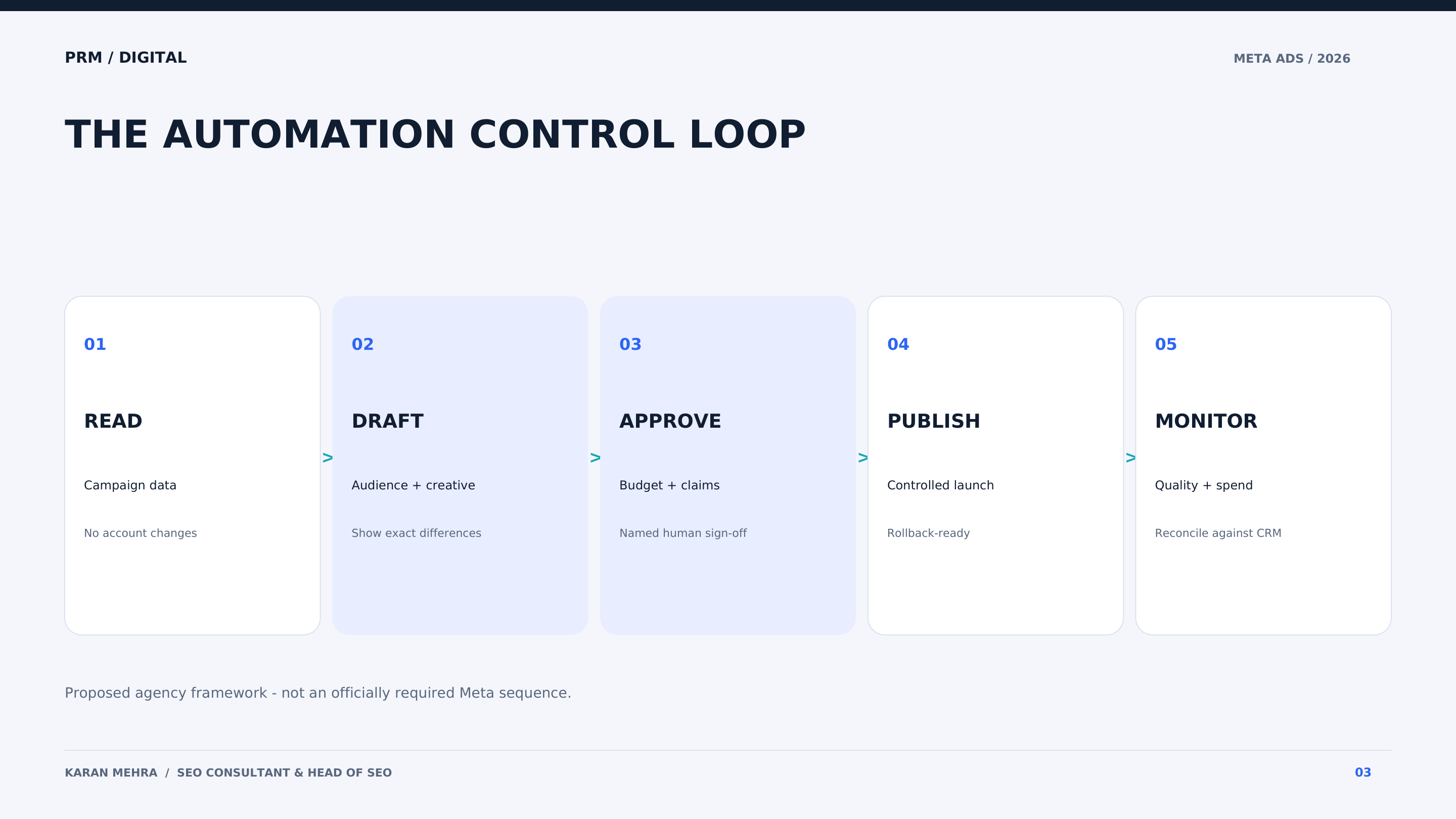
The following is my proposed agency framework, not an official Meta requirement. It translates Meta’s described permissions and drafts into a controlled production process.
- Read: provide the minimum access needed for diagnosis, including campaign objective, exclusions, spend cap, timeframe and trustworthy business outcomes.
- Draft: show proposed edits as old value → new value, with the reason for each recommendation and evidence from the account.
- Approve: require a named human owner for budget shifts, targeting expansion, regulated claims and new customer-data use.
- Publish: release changes in a planned window and preserve rollback details; never assume a chat history alone is a complete audit log.
- Monitor: check pacing, CRM lead acceptance, order quality, creative fatigue, account activity and unexpected edits after launch.
An approval record can be simple: campaign, proposed change, existing values, requested values, evidence, person approving, timestamp and rollback condition. Cross-check the record with Ads Manager’s available change history and access controls. A notification that a task has finished does not prove its changes were correct.
Want a practical account-permissions and spending-risk checklist? Send your Meta Ads setup on WhatsApp: +91 98036 18014
The 14-day pilot: faster work without uncontrolled spend
Days 1–3: establish a business baseline
Define the conversion that matters. For local lead generation, record qualified enquiries, booked calls and sales acceptance—not just instant forms. For ecommerce, record revenue contribution, repeat versus new customers, cancellations and product margins. Note attribution limitations and freeze unrelated changes where feasible so the pilot has a useful comparison.
Days 4–7: start read-only
Use the assistant, where available, to summarize campaign performance, spot creative fatigue, identify plausible audience mismatches and suggest specific tests. Require each recommendation to state its source, period, relevant metric and alternative explanation. Reject advice that sounds impressive but cannot be reconciled with the account or CRM.
Days 8–11: draft real creative hypotheses
Try concepts with distinct persuasion mechanisms: product-in-use evidence, founder explanation, objection handling or customer education. Avoid only swapping colours and headlines while claiming broad creative diversification. Verify offers, landing pages, visual claims and compliance before scheduling. Use an explicit test budget rather than an unbounded campaign increase.
Days 12–14: inspect results and the audit trail
Review changes against a stable baseline and available controls. Monitor qualified CPA, order contribution, creative production hours, approval cycle time, unexpected targeting edits and spend pacing. If qualified outcomes do not improve or reporting is unreliable, keep the assistant advisory rather than expanding its permissions.
For a joined-up paid advertising and measurement program, PRM Digital can help your team build the testing process around commercial outcomes. Review PRM Digital performance marketing services →
Four metrics that matter more than producing ads faster
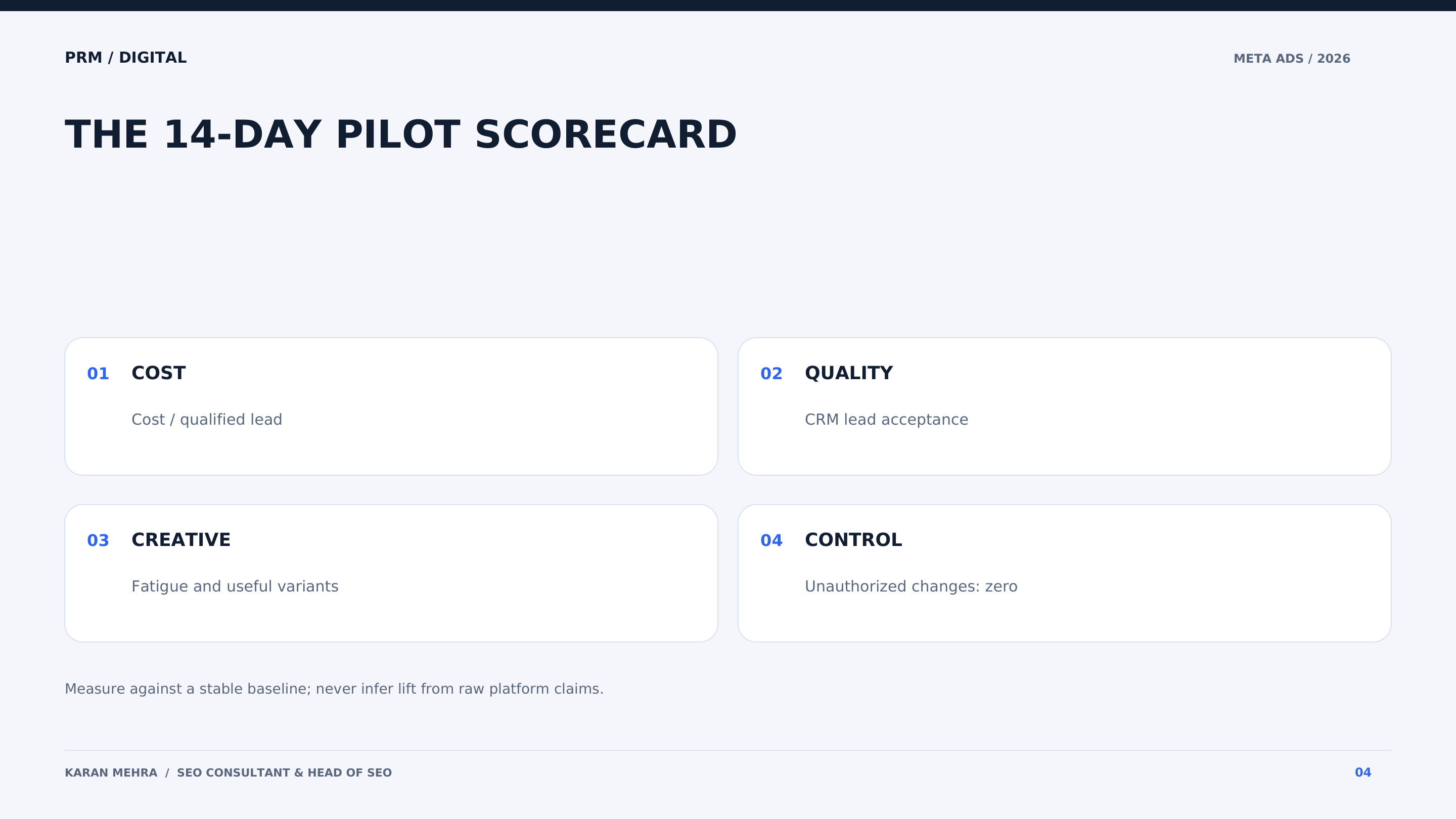
- Cost: cost per qualified lead or acquisition cost for a genuinely new customer rather than blended reported CPA alone.
- Quality: CRM acceptance, booked appointments, order contribution and cancellation rates.
- Creative learning: distinct tested ideas, fatigue trend, claim-review rejections and reasons a winning message worked.
- Safety: unauthorized budget edits, spend variance, missing approvals and time to reverse an incorrect change.
Meta has cited an advertiser comparison associated with adoption of assistant recommendations. That does not prove guaranteed lift for an individual campaign. Treat product-reported averages as context, not a substitute for a controlled account-specific test. In performance reporting, clearly distinguish platform attribution from incremental business impact.
What Indian brands and agencies should do now
First, check which tools are actually accessible inside your account; do not promise a feature purely because it appeared in an international announcement. Second, verify permissions for administrators, employees and outside partners. Third, document customer exclusion and CRM matching. Fourth, set a financial threshold at which any AI-suggested budget change requires human sign-off.
For Indian D2C brands, prioritize product/offer accuracy and meaningful regional-language creative tests. For clinics or financial services, scrutinize regulated messaging and claims. For local service businesses, connect ads to qualified calls and appointments. For B2B agencies, use offline conversion and CRM feedback where appropriate and measure lead acceptance, not form volume alone.
Frequently asked questions about Meta AI Ads
Can Meta’s business assistant change ad budgets for everyone now?
No. Meta’s October 2026 announcement describes conversational budget editing and scheduled tasks as being tested. Actual availability and approval controls must be checked account by account.
Is Ads Creative Studio fully launched?
Meta says it is rolling out to more advertisers after earlier testing. A wider rollout is not identical to universal availability.
Does generative video automatically improve ROAS?
No result is guaranteed by the ability to create video. Test whether the output communicates a meaningful idea, complies with platform policies and produces better qualified outcomes.
What should agencies automate first?
Start with read-only reporting, structured diagnostics, creative hypothesis generation and draft preparation. Expand permissions only after validating the review and rollback process.
What is the best way to measure success?
Use qualified lead or order economics alongside operational speed and control incidents. Avoid treating creative output volume or attributed CPA alone as proof of growth.
The decision for agency leaders
Meta’s AI advertising tools could remove repetitive work from reporting, ideation and setup. They do not remove responsibility for media investment, customer experience or truthfulness. The strongest agency model is faster intelligence paired with better evidence, explicit permissions, human judgment and an audit trail a client can inspect.
Read Meta’s official October 6 announcement for individual feature status. Confirm account-level access before adopting a new workflow; the five-stage loop and 14-day sprint described here are my implementation recommendations.
Need a Meta Ads audit or an AI-assisted paid media test plan tailored to your business? Message me on WhatsApp: +91 98036 18014
Primary and secondary research
Meta Advertising Week 2026 announcement (primary); Social Media Today (Oct 6); MediaPost analysis (Oct 8). Differences between confirmed product rollout, testing and the recommendations in this guide are deliberately labeled.


Leave a Reply