
Published October 10, 2026 · Karan Mehra, SEO Consultant / Head of SEO
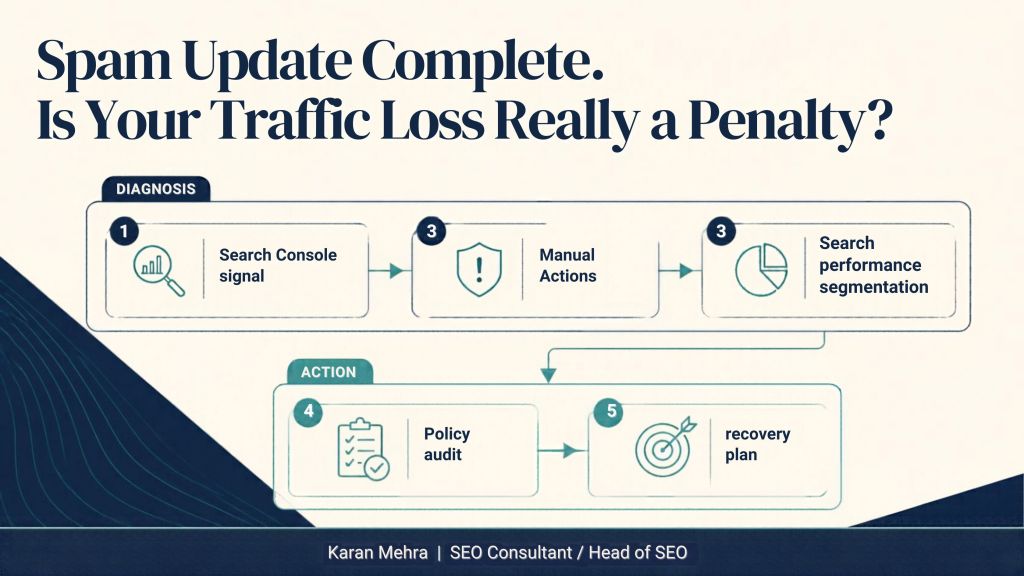
The September 2026 Google spam update is finished. Your recovery plan should not begin with deleting half your website. It should begin with the evidence: when performance changed, which pages or queries changed, whether Search Console shows a manual action, and whether the affected content intersects with Google’s published spam policies.
Google’s Search Status Dashboard records a worldwide, all-language spam update beginning September 24, 2026 and completing October 8. That confirmed completion creates a useful measurement checkpoint. It does not establish that any particular site’s traffic loss was caused by the update. The diagnosis below distinguishes confirmed guidance from an operational framework I recommend.
What actually changed—and what did not
Google recorded the September 2026 spam update on September 24 and confirmed completion October 8. The rollout lasted nearly two weeks, meaning a single-day ranking screenshot during the rollout could mislead. Google’s public entry confirms timing and broad geographic scope; it does not identify new violation categories or explain how individual sites were scored. Source: Search Status Dashboard.
The underlying Google Search spam policies remain the right starting point for a risk review: scaled content abuse, site reputation abuse, link spam, cloaking, doorway abuse, and other manipulative patterns. A September-to-October traffic drop alone is not evidence of those practices.
Need a rapid, evidence-led traffic diagnosis? Discuss the symptoms and affected URL groups with me on WhatsApp: +91 98036 18014
First decision: manual action, algorithmic shift, or something else?
A manual action is not the same thing as an algorithmic ranking decline. If the Manual Actions report in Search Console reports a problem, follow its issue-specific instructions and the documented reconsideration process. If no manual action exists, do not describe a ranking change as a manual penalty. Google’s Search Console and traffic debugging guides recommend investigating traffic patterns, technical issues, seasonality, and search demand before attributing declines to a specific update.
- Manual action found: record the exact affected pages/patterns and violation; remediate the underlying issue; submit a reconsideration request if Google’s instructions require it.
- No manual action, impressions and positions falling: examine page/query cohorts, competitive changes, policy risks, and technical conditions rather than assuming a penalty.
- Clicks fall while impressions are stable: investigate search presentation, CTR, query mix, and SERP changes before editing content.
- Organic sessions differ from Search Console clicks: compare measurement definitions and instrumentation, since GA sessions and GSC clicks are not identical.
The 14-day diagnostic window: what to measure
Use October 8 as the documented completion date, but keep your analysis windows honest. Compare several representative periods before September 24 with the rollout period and then progressively with post-October-8 observations. As of October 10 there are only about two days after completion, so a definitive post-update trend is premature. Search Console data may also be delayed or revised.
1. Export traffic by page type and intent
Segment Search Console clicks, impressions, CTR and average position by landing page and query. Separate category pages, editorial explainers, product pages, location pages, forum/UGC URLs and programmatically generated content. Then split branded versus nonbranded queries, countries, device classes and search appearances where available. Large aggregate averages can hide the fact that one template or country accounts for most losses.
2. Compare the right baseline
Compare weekdays to similar weekdays and consider seasonality, prior-year trends and campaign changes. Check Google Trends where demand may have changed. Align GSC clicks with GA4 organic sessions directionally but don’t force the totals to match. Google’s GSC and Analytics comparison documentation explains different counting systems and canonical URL treatment.
3. Exclude technical failures first
Review server errors, noindex and robots changes, canonical drift, redirects, page availability, indexing reports and deployment history. A migration or accidental template change near the same dates can look like an algorithmic update. Google’s traffic-drop troubleshooting guide explicitly identifies technical issues, seasonality and algorithmic changes as different potential causes.
For cross-functional SEO, analytics and web-development implementation, consider our team at PRM Digital. Explore PRM Digital →
A spam-policy audit built around business risk
Scaled content abuse: audit purpose, not just use of AI
Google defines scaled content abuse as creating many pages primarily to manipulate rankings rather than help people, regardless of whether humans, AI or automation produced the material. Audit near-duplicate templates, thin programmatic landing pages, unreviewed location pages, keyword swaps and low-value AI-generated explainers. Do not assume every AI-assisted page violates policy or that deleting AI text alone is a recovery plan. Google’s explanatory policy post makes the intent and value distinction explicit.
Site reputation abuse: inspect third-party content placement
Review partner sections, white-label directories, syndicated offers and editorial independence. Google clarified that the problem is third-party content exploiting an established host’s ranking signals, not all freelance or syndicated material. A platform’s ownership or oversight arrangements do not automatically make the practice compliant. Confirm whether content serves your established audience and meets policy rather than deleting legitimate editorial contributions indiscriminately. Google’s policy clarification provides examples.
Link and doorway manipulation: match evidence to URLs
Look for networks of keyword-stuffed destination pages, manipulative links or redirects built solely to channel search users into the same commercial outcome. Audit source and destination relevance, editorial uniqueness, and user purpose. Avoid bulk disavows or redirect changes based on a generic algorithm-update narrative.
Unsure whether a template or partner-content section creates policy exposure? Send the affected examples for a focused review: +91 98036 18014
A practical two-week audit plan after October 8
- Days 1–2: capture GSC manual-action status, GSC performance exports, Google update timeline, key business KPIs and deployment history.
- Days 3–4: classify loss by URL template, query intent, country, device and search appearance; compare similar weekdays and prior-year demand.
- Days 5–6: investigate crawl/indexing and analytics discrepancies; independently validate any technical failures.
- Days 7–9: review the largest affected cohorts against relevant spam-policy sections; document page-level examples, intent and user value.
- Days 10–12: prioritize reversible, evidenced fixes: broken canonical signals, low-value duplicate patterns, deceptive redirects or policy-violating placements.
- Days 13–14: create a monitoring dashboard with owners, dates, annotations and business outcomes; schedule follow-up measurements rather than claiming immediate recovery.
Decision rule: changes should correspond to diagnosed evidence. If the most affected cohort has no policy issue but a clear tracking break or a market-demand shift, the response should not be a spam-remediation project. This decision matrix is my practical recommendation, not a proprietary Google ranking formula.
How to report results to leadership without inventing causality
Create a brief executive table with four columns: affected cohort, observed change, evidence supporting the leading explanation, and next validated action. Add transaction or lead value where available. Report the difference between a confirmed event (‘Google’s spam update completed October 8’) and a hypothesis (‘our product-category traffic decline may be related’). Google’s analytics documentation supports comparing organic discovery data with on-site business outcomes, with metric differences made explicit.
PRM Digital works across SEO, website development and performance marketing. If your diagnosis spans those systems, explore an integrated implementation review. Explore PRM Digital →
FAQs
When did the September 2026 Google spam update finish?
Google’s Search Status Dashboard records completion on October 8, 2026. It began September 24 and applied globally, across languages.
Does a traffic drop after the update mean a Google penalty?
No. A traffic decline is an observation, not proof of a manual action or even proof the update caused it. Check Search Console Manual Actions and investigate technical, demand, competition and policy factors.
Should I delete AI-generated articles after a spam update?
Not solely because AI contributed to their creation. Google’s scaled content abuse policy focuses on producing pages at scale primarily to manipulate rankings without helping people. Evaluate each affected cohort for originality, purpose and usefulness.
Can rankings recover immediately after I change a page?
There is no guaranteed recovery deadline. Reprocessing and systems’ reassessment can take time, and some apparent declines may have unrelated causes. Avoid promises of a fixed recovery period.
How many days of data are enough?
As of October 10, the post-completion window is too short to draw robust conclusions. Start collecting segmented observations now, and extend the comparison as new complete data becomes available.
Conclusion: diagnose before prescribing
Google’s September 2026 spam update is over, but an honest recovery audit has only just begun. Separate manual actions from algorithmic changes, diagnose which pages and queries were affected, cross-check Search Console against technical and commercial signals, then act on verified problems rather than speculation. The best post-update SEO decisions are documented, reversible where practical, and measured against business outcomes—not ranking anecdotes.
Want help prioritizing your traffic-loss investigation? Message me directly: +91 98036 18014


Leave a Reply