
By Karan Mehra · Updated 9 October 2026
A community post can be useful while a conversation is happening and almost irrelevant by the time a searcher finds it. That timing problem is the commercial reason SEO teams should pay attention to Google’s UGC Fresh Data Program. The first decision is whether your platform has the operating capacity to participate.
Google’s documentation changelog records the new guidance on 8 October 2026. This article separates the published requirements from a proposed implementation plan. The roadmap, metrics and business recommendations below are Karan Mehra’s analysis, not additional Google eligibility rules.
What is the Google UGC Fresh Data Program?
According to Google’s program documentation, approved UGC platforms can send fresh content and interaction signals through a dedicated pipeline. It operates separately from general crawling and the Google Indexing API. Search inclusion is not guaranteed.
Who can apply?
The published criteria cover substantial UGC volume and audience; stable individual post URLs; public access and creator profiles; OAuth 2.0 capability; validated JSON-LD and on-page structured data; moderation and user reporting. Submissions should arrive within minutes, with engagement updates during the first 72 hours. Google supplies integration details after acceptance and indicates an application response window of six to eight weeks.
Google has not published a numeric audience threshold on the overview page. An application should describe actual content volume, audience and engineering capacity rather than invent a qualifying minimum. Ordinary company articles do not become independent user content merely because a CMS labels them posts.
Request a technical SEO readiness review. Map your public post pages, creator profiles and moderation ownership before you commit development time.
The platform readiness test
Treat readiness as a set of dependencies, rather than a single SEO score. In our proposed audit, each dependency needs an owner, evidence, a failure scenario and a recovery procedure. A green status without evidence should not pass the review.
Public-page evidence: Sample newly created posts, older threads and edited posts without signing in. Record the URL, the visible author and whether the content matches what the platform intends to distribute. Include mobile checks: a desktop-only inspection can miss intrusive overlays and broken navigation.
Attribution evidence: Check whether a reader can move from a contribution to a meaningful creator profile. Review what happens when someone changes a display name or removes an account. Product and privacy teams should decide the appropriate public information before engineering builds the dependency.
Moderation evidence: Trace a reported contribution from user report to review and final action. Test the process outside normal business hours. A reporting button proves only that a report can enter the system; the operating test is whether someone owns the resulting queue.
Data evidence: Compare timestamps, creator references and interaction counts across the public page and the internal record. Build a small set of difficult examples: an edited post, a deleted comment, a duplicate event and a thread with delayed engagement updates.
A proposed ingestion architecture
Before receiving Google’s integration documentation, design the internal controls you will need regardless of the final endpoint. This is a conceptual architecture, not a description of an undocumented Google API.
A practical internal sequence is: contribution created → moderation decision → canonical content record → validation → eligible outbound queue → delivery log. Keep the original event time and each processing timestamp. That lets the team distinguish slow moderation from a queue backlog instead of blaming both on “indexing delay.”
Make retry handling part of the design. A transient failure should create a bounded retry with an audit trail, not an uncontrolled stream of duplicate submissions. Decide who can pause the outbound queue and how the team will inspect a failed record. Implement Google-specific payloads, endpoints and limits only from the documentation supplied during onboarding.
Discuss your implementation plan. Give SEO, engineering and trust-and-safety one shared readiness register with named owners.
Measure operations separately from Search results
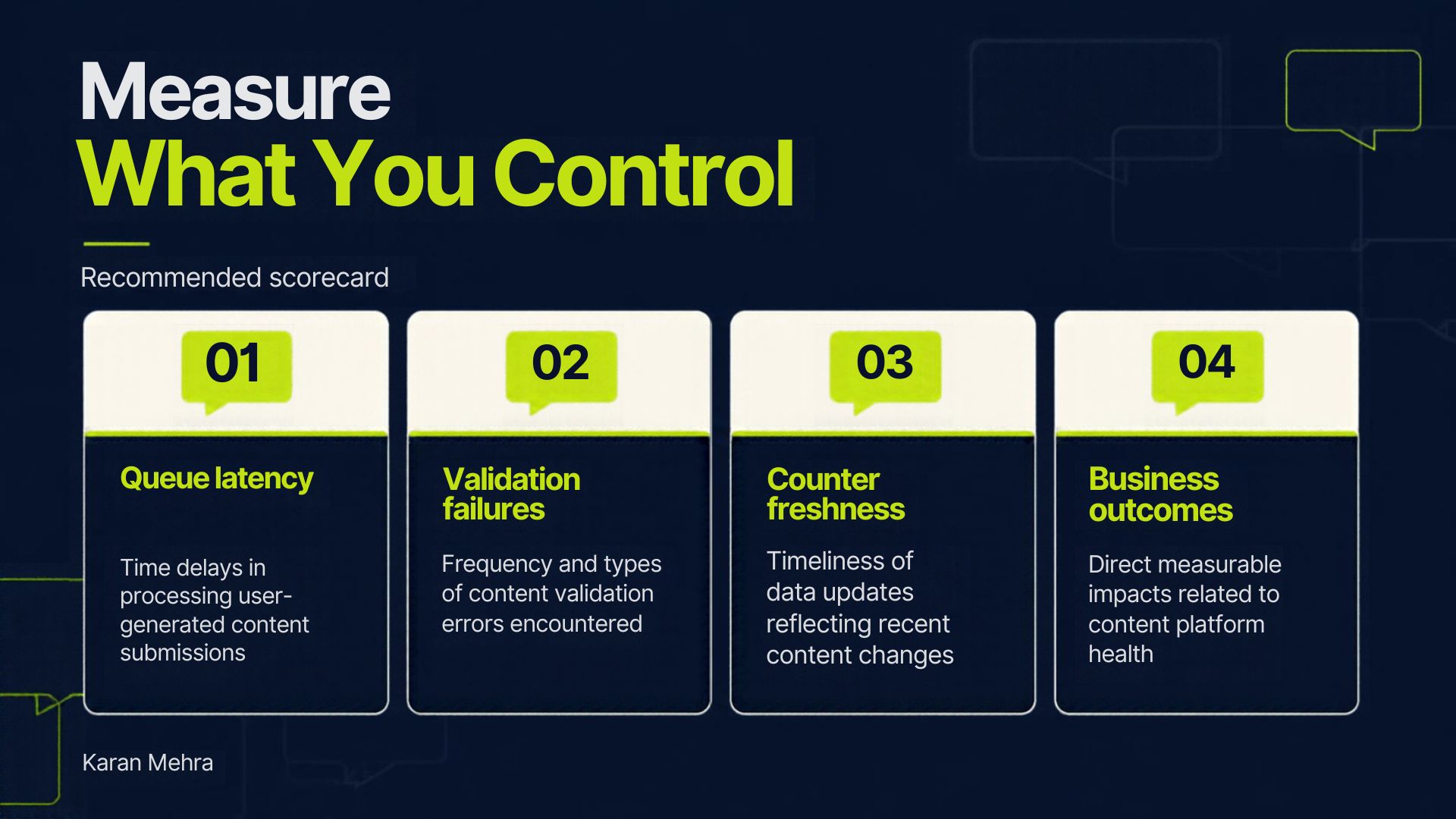
The following scorecard is a recommended management framework. It does not imply that Google provides every downstream processing timestamp or guarantees a latency target.
Publication-to-queue latency: Measure the difference between the original publishing timestamp and the point at which your outbound record is ready. Track the median and the 95th percentile so a small group of delayed records cannot hide behind a good average.
Validation failure rate: Divide rejected internal records by attempted records. Group failures by cause and owner. A weekly percentage is less useful if a recurring creator-reference fault remains unidentified.
Engagement freshness: Track how old your last recorded counters are for the eligible content set. Compare operational freshness with the public page; do not claim visibility gains merely because your counters update more frequently.
Search and business outcomes: Use available Search Console performance data and your analytics to assess impressions, clicks, engaged visits and meaningful conversions. Keep brand and non-brand trends separate where the data supports it. Report unknowns rather than assigning every movement to the new pipeline.
An illustrative evaluation: choose comparable topic groups, establish a baseline and note simultaneous product or marketing changes. A traffic increase during a major seasonal event is weak evidence of pipeline impact. This framework helps assess association; it is not a randomized experiment and cannot establish causality by itself.
A 30-day preparation roadmap
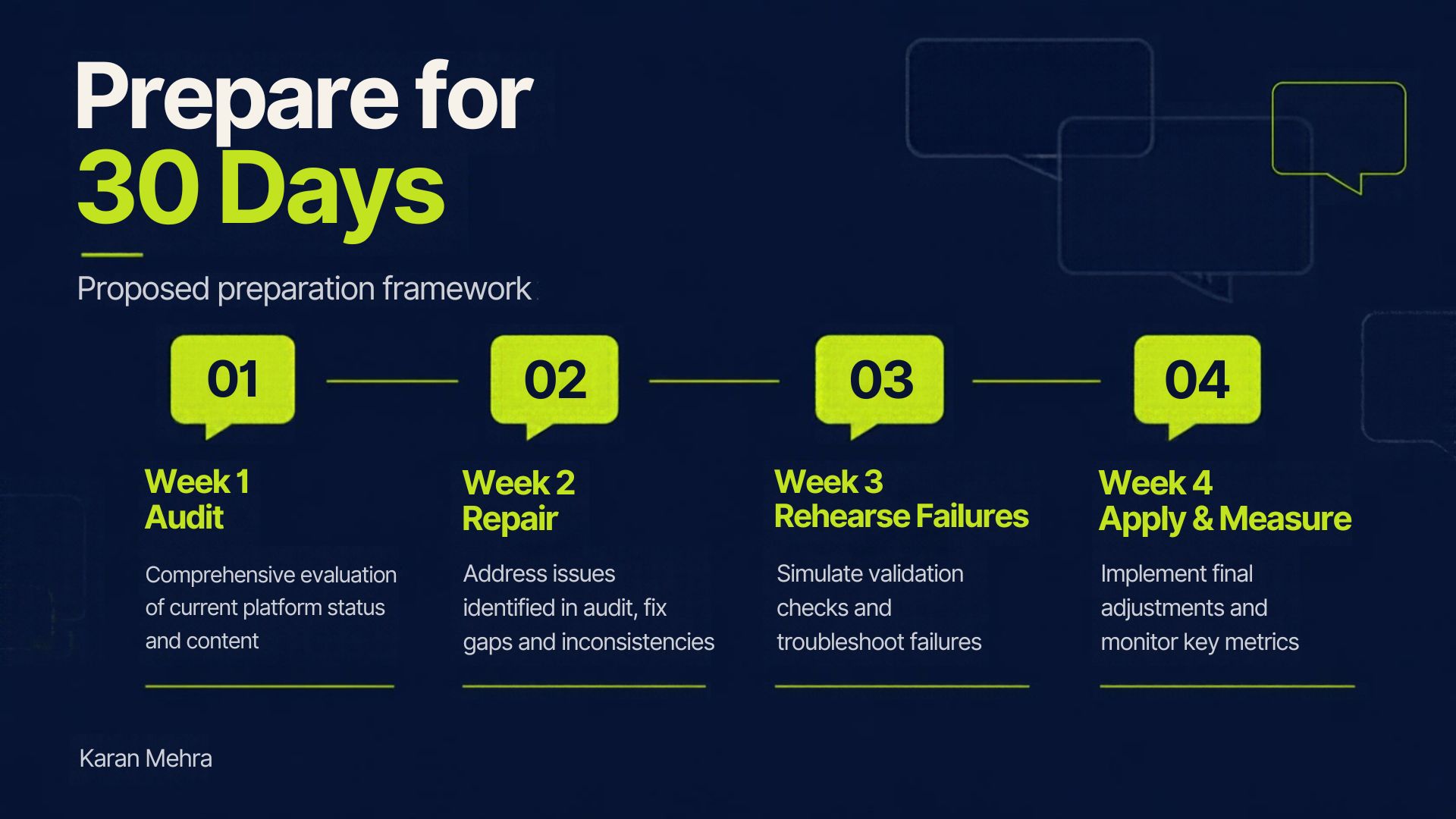
Days 1–7: establish the evidence. Inventory representative content types and public URLs. Identify creator-profile gaps, moderation bottlenecks and missing event timestamps. Document the actual audience and content volume. Finish the week with a go/no-go recommendation supported by examples.
Days 8–14: repair the common dependencies. Prioritize broken public pages, inconsistent records and missing ownership. Improve on-page structured-data implementation using the applicable official guidance. Build internal validation samples rather than guessing the future submission contract.
Days 15–21: rehearse failure. Run a small internal queue and inspect retries, stale counters and moderation reversals. Test what happens when an owner is unavailable. Decide how to investigate a failed delivery without exposing account credentials or unnecessary creator information.
Days 22–30: prepare the application and measurement plan. Assemble the evidence, maintenance estimate and operational owners. Record a baseline before any integration begins. This month is a preparation window, not a promise that acceptance or onboarding will finish in 30 days.
Get your next fixes prioritised. Fix the dependency that blocks readiness first; avoid spending a month polishing an application while the public content experience remains broken.
The commercial decision for SEO leaders
Estimate the opportunity before you approve integration costs. A platform with conversations that change quickly may have a stronger freshness use case than one whose value comes from evergreen reference material. That is a business hypothesis to test against your content and analytics, not a published selection criterion.
Build three planning scenarios: no measurable lift, modest lift and a stronger lift. Include engineering maintenance, monitoring and moderation capacity in each. An optimistic traffic forecast without ongoing operating costs is not an investment case.
The readiness work can still improve the platform if an application is unsuccessful: consistent public records make debugging easier, ownership shortens internal handoffs, and clearer creator attribution helps readers understand whose experience they are seeing. Those benefits should be measured in their own right.
Frequently asked questions
Does this replace ordinary technical SEO? The program’s separate pipeline does not remove the need to maintain a usable public site. Keep auditing the reader experience and the content lifecycle.
Can we implement the integration today? Prepare your internal systems and evaluate eligibility now. Wait for the official onboarding specification before implementing Google-specific submission behavior.
What should a small business do? Assess whether it actually operates a qualifying UGC platform. If it mainly publishes its own service pages and articles, its immediate priorities will usually be improving those pages and measuring their business contribution.
Should we promise clients an indexing improvement? Set expectations around the work you control: readiness, validation, ownership and measurement. Treat any Search improvement as an outcome to verify.
Bring your toughest visibility gap for review. Bring one public thread, its creator profile and its moderation history to your next team review. Find the first broken dependency before approving a wider project.
Sources and editorial notes
Primary references: Google’s UGC Fresh Data Program overview and Search Central documentation updates. Checked on 9 October 2026. The readiness test, architecture, scorecard and roadmap are an original advisory framework; they are not Google’s integration specification.


Leave a Reply