
Updated 8 October 2026 · By Karan Mehra, SEO Consultant / Head of SEO
The next ecommerce bottleneck may not be a ranking problem. It may be the moment an AI shopping assistant tries to create a cart, calculate shipping, or complete an order—and your systems cannot answer correctly.
Google’s Universal Commerce Protocol (UCP) integration hub in Merchant Center makes that distinction operational. Google’s official documentation describes an onboarding and testing environment connecting AI shopping experiences with retailer commerce systems. The hub is gradually rolling out in the United States, and native checkout remains an early-access capability for selected merchants. This is not a universal launch, a ranking update, or an immediate checkout option for Indian retailers.
My assessment: marketing teams should stop treating agentic commerce as another search-result placement to optimize. The opportunity is a joint program spanning product data, checkout engineering, inventory accuracy, customer service, payments, analytics and commercial governance.
What changed in Merchant Center in October 2026?
The immediate development is a dedicated Settings → UCP integration workflow for participating merchants. Google’s implementation guide, updated 5 October 2026, describes three stages: implement the selected UCP capability, test it in a sandbox, then validate the production integration. An Analytics tab is documented for participating merchants. Industry reporting published on 7 October highlighted the gradual US rollout.
This matters because onboarding moves closer to the place merchants already manage product feeds and shopping eligibility. It does not mean every Merchant Center account can enable checkout today. Google’s documentation currently scopes the hub to products sold within the United States, identifies Australia and Canada as later markets, and does not list India.
CTA — Leading a retail growth team? Audit commerce readiness before assigning another AI-visibility KPI. Explore next steps →
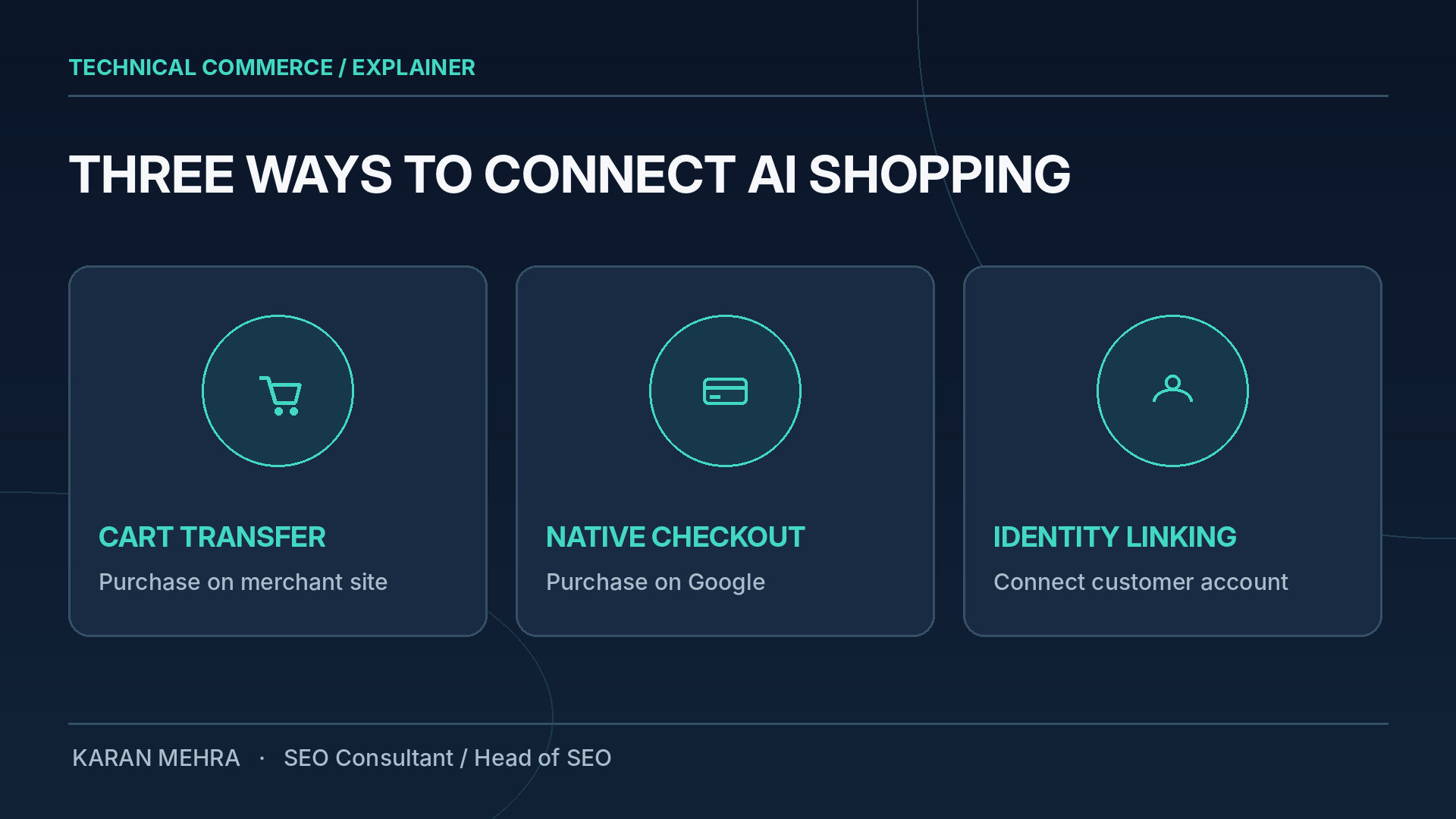
The three UCP routes are not interchangeable
A useful decision starts with a simple question: Where should the customer finish the purchase? The answer determines the engineering work, customer experience, data controls and measurement.
1. Transfer to merchant cart: keep checkout on your site
Under the Cart API path, the shopper builds a basket in a Google experience. Your service receives a cart-creation request and returns a continuation URL to a pre-populated cart on your website. The current Cart API overview specifies a one-way transfer built around CreateCart; do not assume full bidirectional cart synchronization.
This path may suit merchants who need to retain their existing checkout, cross-sell modules, fraud controls and consent flows. But a prefilled cart is not a completed order. The retailer still owns the last-mile conversion experience.
2. Native checkout: complete the purchase on Google
For the native path, Google’s validation checklist calls for checkout-session creation, updates and completion, order-status integration and production approval. Shipping, taxes, inventory and payment handling must remain accurate when a shopper changes details.
The operational risk is straightforward: a product can look available in a shopping experience while the checkout API discovers that stock, shipping or price has changed. If error handling is poor, the customer encounters friction precisely where the new experience was intended to remove it.
3. Identity linking: connect an authenticated customer
Identity linking is an optional capability associated with native checkout. It uses OAuth 2.0 to connect a shopper with a merchant account for relevant authenticated experiences, including loyalty benefits. It is not a substitute for checkout APIs and should not be added without a clear privacy, consent and customer-service design.
The product-feed detail that can quietly block checkout
For native checkout, Google requires the product-level attribute native_commerce(checkout_eligibility). Its Merchant Center implementation guide says missing or FALSE values mean a product is not eligible for the direct checkout experience. Google recommends a supplemental data source to reduce the risk of disturbing an existing primary feed.
Two other details deserve attention. First, the product id in Merchant Center must match the identifier expected by the checkout API; merchant_item_id can bridge a mismatch. Second, regulated products may require a consumer_notice with the correct warning type and message. Feed hygiene here is not merely about listing coverage—it can determine whether a supported purchase flow works.
Example: a retailer’s Merchant Center feed uses SHOE-BLK-42, while its order service expects SKU-001842. A conventional ranking audit would miss this. A UCP integration audit checks identifier mapping before a shopper reaches checkout.
CTA — If your feed IDs, stock system and checkout API disagree, fix that gap before testing AI checkout. Explore next steps →
Four implementation failures that can destroy the business case
- Product ID drift. A feed identifier, warehouse SKU and API item ID point to different records, causing rejected carts or incorrect variants.
- Inventory and pricing latency. The purchase flow must recheck availability and compute accurate totals rather than trusting stale feed values.
- Incomplete checkout error handling. Shipping-address failures, out-of-stock items and payment errors need recoverable, intelligible responses where supported.
- Missing order observability. Marketing sees a Buy button click, but operations cannot reconcile checkout sessions, successful purchases, cancellations and refunds.
Google’s UCP FAQ makes several responsibilities explicit: the retailer remains Merchant of Record, performs real-time inventory checks, validates shipping destinations and maintains transaction records. Crucially, Google says native UCP integration does not improve the ranking of product offers. The value proposition is a different purchase experience, not a search-ranking shortcut.
A practical 30-day UCP readiness sprint
Days 1–7: Decide whether the channel is relevant
Confirm the market, eligibility and program access before allocating engineering budget. For an India-only merchant, treat this as capability planning rather than an active integration launch. For a participating US merchant, map the decision between cart transfer and native checkout against existing conversion rates, margins, returns and customer-support obligations.
Days 8–14: Reconcile the catalog and checkout contract
Export a representative set of products covering variants, discounts, out-of-stock cases and regulated categories. Verify product ID mapping, currency, shipping zones, return policies, customer-service details and required notices. Document the system of record for each value.
Days 15–21: Test failure paths, not only the happy path
Use the Merchant Center sandbox to test cart creation or native checkout session creation, updates and completion, depending on the chosen capability. Include expired carts, stock changes, invalid addresses, changed shipping fees, duplicate requests and authentication failures. Keep separate test and production credentials.
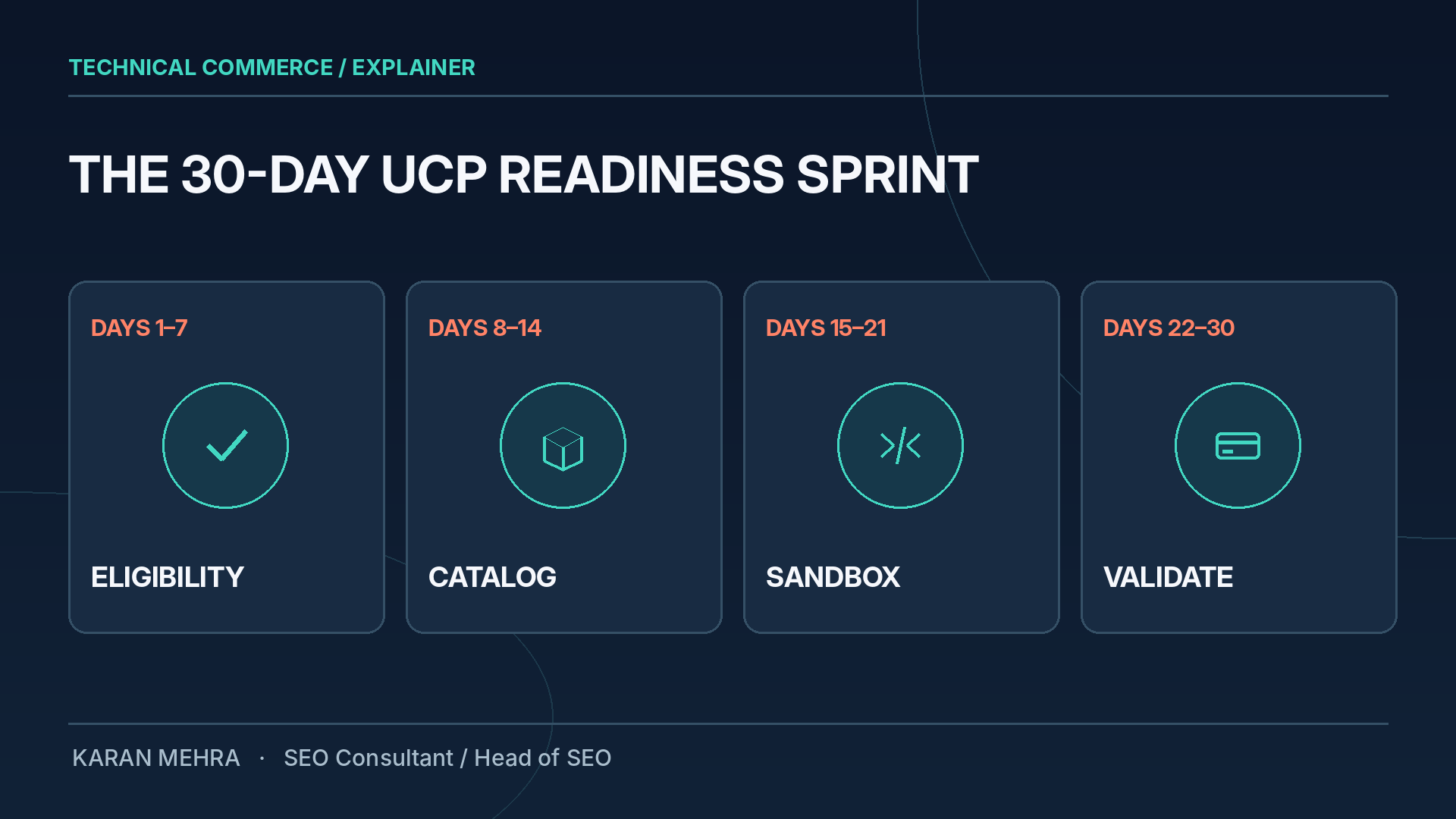
Days 22–30: Validate production and define ownership
Publish the UCP technical profile at /.well-known/ucp with only the capabilities you actually support. Complete Google’s validation process and obtain approval before claiming the integration is live. Assign named owners for API uptime, order reconciliation, inventory quality, customer support and incident response.
CTA — Planning a rollout? Start with a 30-day catalog, API and measurement review—not a speculative traffic forecast. Explore next steps →
Measure purchases, not just AI visibility
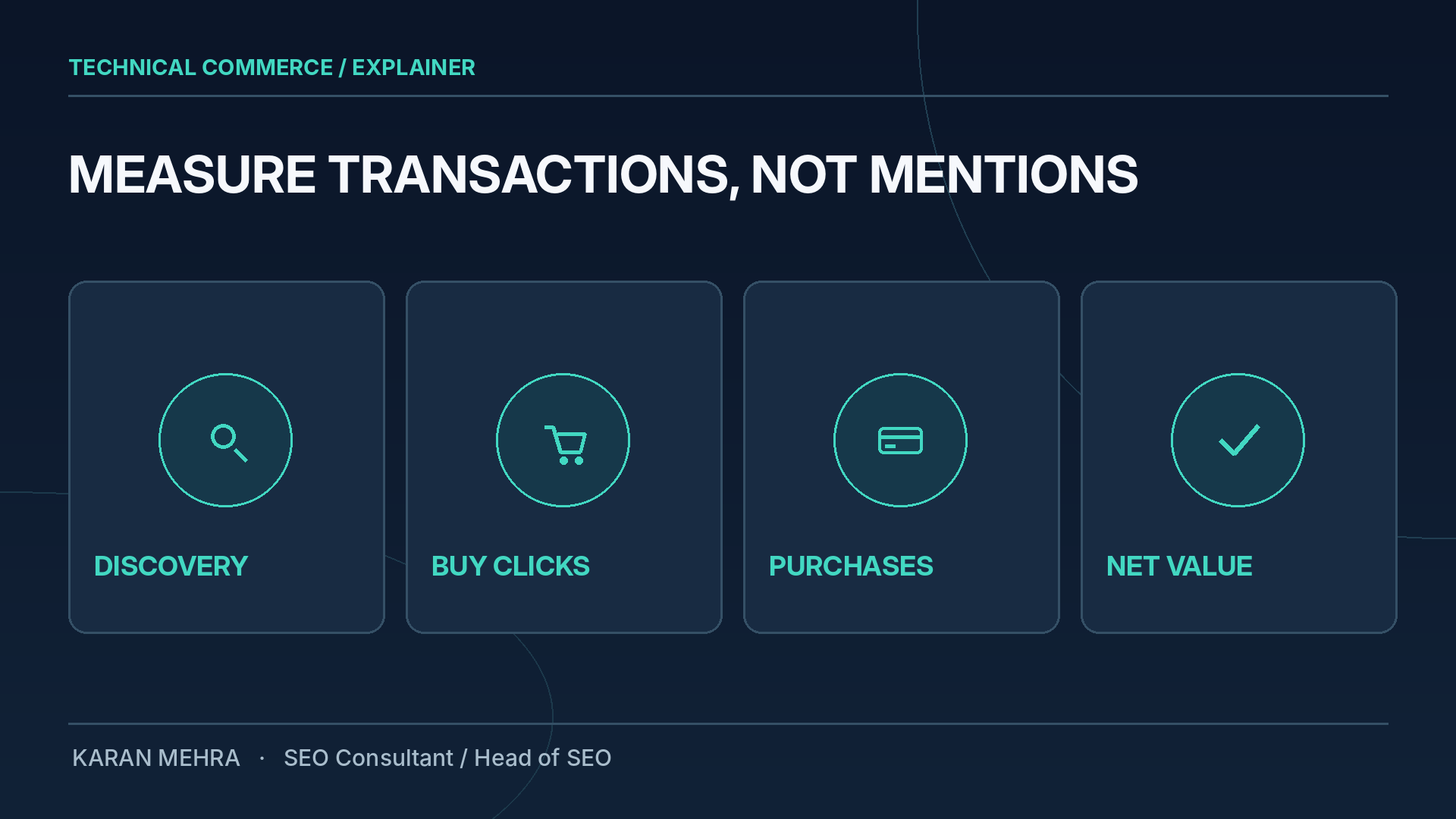
The UCP Analytics dashboard documents Clicks to Buy, Purchases, Purchase Rate, Average Order Value, Cancellations, Account Linking and top-selling UCP products. Google also documents an experimental Merchant API reporting view for account- and product-level performance.
A useful reporting design connects those funnel metrics to net revenue and operating cost. More Buy-button clicks are not necessarily an improvement if completed orders do not rise, cancellation rates worsen or customer-service costs increase. Compare UCP-enabled cohorts with appropriate baselines; avoid claiming incremental lift from a simple before/after trend.
I would give leadership a scorecard covering eligible SKU coverage, checkout API success rate, checkout latency, Clicks to Buy, completed orders, purchase rate, AOV, cancellations/refunds and contribution margin. This is my proposed operating framework, not a Google-defined ranking score.
What Indian ecommerce brands should do now
The current Merchant Center UCP hub is not an India launch. Indian brands should avoid spending on an integration that is not yet available to them. There is still valuable preparatory work: maintain accurate Merchant Center data, normalize variant identifiers, document API ownership, monitor inventory latency, and strengthen consent-aware first-party measurement.
For exporters with US-market operations, the relevant question is whether their eligible products and merchant setup fall within Google’s documented program scope—not where their headquarters happens to be. Verify eligibility with Google and your platform provider before making commitments.
Frequently asked questions
Is the Google Merchant Center UCP integration hub available in India?
Not under the rollout described in Google’s October 2026 documentation. The hub is gradually rolling out for products sold in the United States; Australia and Canada are planned for later.
Does enabling UCP improve Google Shopping rankings?
No. Google’s FAQ explicitly says opting into native integration does not affect product-offer rankings. It changes the potential purchase experience for eligible listings.
Can a retailer use UCP without checkout happening on Google?
Yes. The cart-transfer path sends a pre-populated basket to the merchant website for checkout. Its current documented implementation centers on a one-way cart creation and handoff.
Is a UCP integration just a Merchant Center feed change?
No. Native checkout requires backend APIs, payment handling, order lifecycle integration, production validation and operational support. Feed eligibility is only one component.
Which metrics matter most for UCP performance?
Start with Clicks to Buy, completed Purchases, Purchase Rate, AOV and Cancellations. Add technical success rates, net revenue and support burden from your own systems.
Does UCP make Google the merchant of record?
No. Google says the retailer remains Merchant of Record and retains responsibility for customer relationships, inventory checks and order obligations.
The leadership decision
The UCP integration hub signals that AI-driven commerce is moving from product discovery toward transactional infrastructure. The credible response is neither panic nor an unsupported prediction that every sale will happen inside an assistant. It is to identify where your catalog, APIs, fulfilment and measurement would fail under a new checkout path—and correct those failures deliberately.
For eligible merchants, that work can support a disciplined pilot. For everyone else, it creates a useful readiness roadmap. Either way, the commercial question is not simply whether an AI system mentions your products. It is whether your business can reliably turn a qualified shopping moment into a profitable, supportable order.
CTA — Need a practical SEO-to-commerce systems audit? Prioritize the gaps that affect transactions, not vanity visibility metrics. Explore next steps →
For a related technical SEO operations example, read how to handle Googlebot overload and Retry-After without causing an SEO incident.


Leave a Reply