
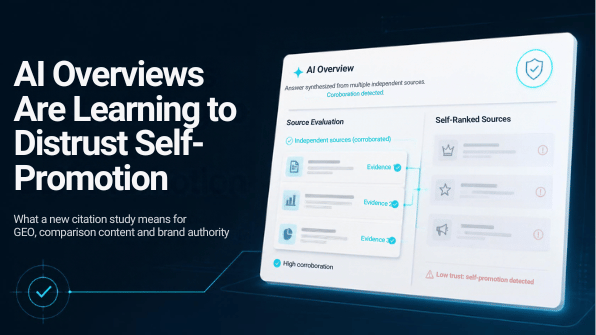
The easiest GEO tactic in B2B software has always had an obvious credibility problem: publish a “best tools” list on your own domain, put your product at #1, and hope an AI answer repeats the claim. Fresh evidence suggests that loophole is getting less dependable.
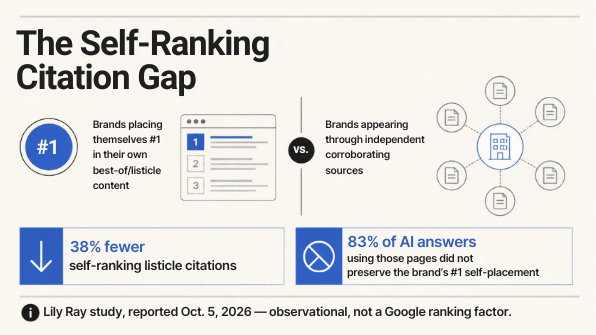
On October 5, 2026, PPC Land reported an updated analysis from SEO and AI-search consultant Lily Ray covering 100 “best B2B software” queries. In the September sample, Google AI Overviews cited 38% fewer vendor-written self-ranking listicles than in Ray’s earlier measurement. More strikingly, when an AI Overview did cite one of those pages, the brand that ranked itself first was absent from the recommendation 83% of the time. In 70% of cases, the page reportedly helped competitors get recommended while its publisher was left out.
Those numbers are useful, but they are not a Google ranking-factor disclosure. This is a practitioner study in one vertical, on one AI surface, using a 100-query sample. PPC Land explicitly notes that the work has not been independently audited and that other datasets have produced different results. The right conclusion is not “self-ranking pages are dead.” It is more operational: citation and recommendation are different outcomes, and self-assertion is a weak substitute for corroborated authority.
That distinction matters because Google’s own current guidance for generative AI search now tells site owners to focus on unique, non-commodity content and warns that seeking inauthentic mentions is less useful than it may appear. Google also says AI Overviews and AI Mode rely on core Search ranking and quality systems, using retrieval and query fan-out to ground answers in web sources.
What the new self-ranking data actually shows
Ray’s June 2026 study already exposed a gap between being used as a source and being selected as the answer. Search Engine Land reported that, across 100 B2B “best [category] software” queries, 80 triggered AI Overviews. Vendor-owned listicles were cited 323 times, yet in 224 of those citations—69%—the publishing brand was not recommended.
The September update moves that pattern further. According to PPC Land’s October 5 report, the “cited but not recommended” rate for the self-ranked brand rose to 83%, while citations to vendor-written self-ranking pages fell 38% versus June.
| Signal | June 2026 | September 2026 update |
|---|---|---|
| Queries studied | 100 B2B software queries | 100 B2B software queries |
| Self-ranked brand excluded when its page was cited | 69% | 83% |
| Change in citations to vendor self-ranking pages | Baseline | 38% fewer, per Ray |
| Publisher page helped competitors get recommended | Pattern observed | 70%, per Ray |
The important measurement lesson is simple: a citation is not a recommendation. A page can supply evidence or entities to an AI-generated answer without the model concluding that the page’s publisher is the best choice.
Why this is bigger than one GEO tactic
Self-ranking listicles worked because they collapsed three different jobs into one page: category definition, competitor comparison and brand promotion. For a conventional search result, that page could still win clicks if it ranked. In an AI answer, however, the system can extract the useful category information and separate it from the publisher’s promotional conclusion.
Google’s official generative-AI optimization guide explains that its AI search experiences use retrieval-augmented generation and query fan-out. In plain English, the system can issue related searches, retrieve multiple sources and use those sources to ground an answer. Google explicitly recommends unique, expert-led, non-commodity content and says businesses should not chase inauthentic mentions or rewrite content solely for AI systems.
That architecture creates a strategic problem for self-serving comparisons. Your page may be useful enough to help Google understand the category while your claim that “we are #1” remains unsupported outside your own domain.
The shift: from self-claimed authority to corroborated entities
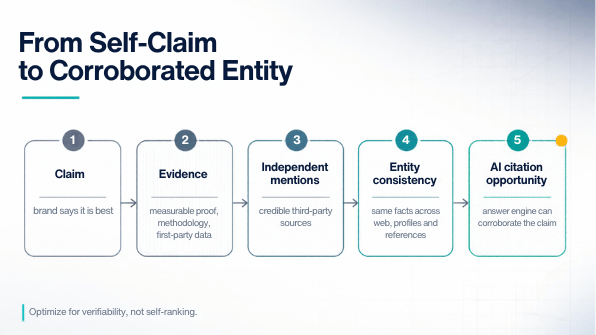
For SEO leaders, I would stop framing GEO as “how do we get our page cited?” and start framing it as “what evidence would an answer engine find if it tried to verify our claim?”
1. Separate the claim from the evidence
If you publish “best CRM for agencies,” do not make the methodology a decorative paragraph below the rankings. Define the evaluation criteria, data source, testing process, limitations and commercial relationship before the recommendation. A comparison that cannot explain why one product wins is advertising dressed as research.
2. Build facts that other sources can verify
Original benchmarks, product data, customer outcomes, transparent pricing, documented capabilities, public changelogs and named expert analysis give other publishers something concrete to reference. “We are the best” is not a fact an AI system can independently verify. “Median implementation time was 18 days across 64 deployments, with methodology disclosed” is at least testable.
3. Earn independent category inclusion
Google’s guidance is unusually direct here: seeking inauthentic mentions is not a durable shortcut. The goal is not to manufacture a web-wide echo of your marketing copy. It is to create enough real market evidence that independent sources—publishers, customers, analysts, communities, videos and expert discussions—describe the same entity accurately.
4. Keep entity facts consistent
Product names, company relationships, pricing models, target audience, locations, leadership and core capabilities should not contradict one another across your website, profiles, documentation and third-party references. Consistency does not guarantee an AI citation, but inconsistency makes corroboration harder.
What I would change in a B2B content program this quarter
If a site has spent the last year producing hundreds of “best X” and “X alternatives” pages, I would not delete them blindly. I would segment them by commercial value, organic visibility, AI citation visibility and evidence quality.
- Inventory self-promotional comparisons. Flag every page where your own product is ranked, scored or recommended.
- Audit methodology. Can a reader reproduce or understand the ranking logic? If not, rebuild the page around explicit criteria.
- Measure citation versus recommendation. Track whether AI Overviews cite the page, mention the brand, recommend the brand, or recommend competitors. Those are four different metrics.
- Add information gain. Replace generic feature summaries with first-party testing, original data, screenshots, expert observations and decision criteria.
- Map corroboration gaps. For each important claim, identify whether an independent credible source supports it. Where none exists, decide whether the claim is genuinely defensible.
- Remove manufactured authority tactics. Do not buy undisclosed “best of” placements or fabricate consensus. Google’s AI-search guidance specifically warns against inauthentic mentions, and its spam policies apply to generative AI responses in Search.
This also changes reporting. A GEO dashboard that celebrates “citations” without measuring whether the brand is actually recommended can create false confidence. For commercial queries, I would report at least four layers: source citation, brand mention, recommendation inclusion and downstream conversion.
A practical AI citation-readiness audit
Before publishing a category or comparison page, ask six questions:
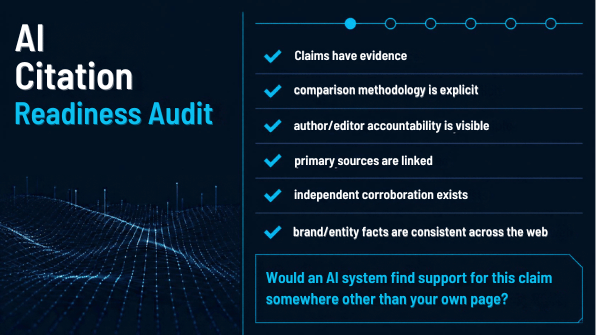
- Does every major claim have evidence?
- Is the comparison methodology explicit?
- Is there a real accountable author or editor?
- Are primary sources linked where they exist?
- Can important claims be corroborated outside our own domain?
- Are our brand and product facts consistent across the web?
If the answer to the fifth question is consistently “no,” the problem is probably not your prompt engineering, schema or paragraph length. It is an authority gap.
What this does not prove
It would be irresponsible to turn a 100-query study into a universal law. We do not know the full sampling methodology, the exact matching between the June and September query sets, or whether the same pattern holds across healthcare, ecommerce, local services or other AI surfaces. PPC Land also notes that other datasets have produced different results.
Nor has Google announced a “self-ranking listicle penalty.” Google’s public documentation does not name this page format as a ranking factor. What Google has said is that its generative AI features depend on Search quality systems, that spam policies apply to generative AI responses, and that inauthentic mentions and low-value, commodity content are not the direction site owners should pursue.
That is enough to make a business decision without pretending we know more than we do.
The business implication: GEO is becoming an evidence problem
The early phase of AI-search optimization rewarded tactics because the systems were new and the gaps were obvious. The next phase will be harder to fake. Brands need to become easier to verify, not merely easier to mention.
For CMOs and Heads of SEO, that pushes GEO beyond the content team. Product has to produce defensible facts. Customer success has to surface outcomes. PR has to earn independent coverage. SEO has to make the evidence crawlable and understandable. Analytics has to distinguish citation from recommendation and recommendation from revenue.
That is a more demanding operating model than publishing another “10 best tools” page. It is also much harder for a competitor to copy.
Frequently asked questions
Do self-ranking listicles still work in Google AI Overviews?
They can still be cited. The fresh study does not show that Google has eliminated them. It shows that citations to these pages declined in the measured sample and that being cited often did not translate into the publishing brand being recommended.
Is being cited in an AI Overview the same as being recommended?
No. Ray’s research is specifically valuable because it separates the two. A page may supply information to an AI Overview while the answer recommends another company.
Does Google penalize brands for ranking themselves first?
Google has not announced a specific penalty for the format. Its published guidance instead focuses on content quality, spam policies, non-commodity value and avoiding inauthentic mentions. Treat any claim of a dedicated “self-ranking penalty” as unconfirmed unless Google documents it.
What should replace self-promotional “best” pages?
Not necessarily a different page type. Keep useful comparison pages where they serve buyers, but make the methodology transparent, use first-party evidence, disclose commercial interests and build independent corroboration around the claims that matter.
The takeaway
The strongest lesson from the latest Google AI Overview citation data is not that listicles are finished. It is that self-promotion is becoming less useful as a substitute for market evidence.
If your GEO strategy depends on your own website repeatedly telling AI systems that your brand is the best, you are building on a weak signal. Build the evidence, earn independent corroboration, keep entity facts consistent and measure whether the system recommends you—not merely whether it cites you.
For more on how I approach AI Overviews and generative search alongside technical SEO, see my SEO services and GEO work. For Google’s current first-party guidance, read its guide to optimizing for generative AI features. The fresh study is documented in PPC Land’s October 5 analysis, with the earlier June study covered by Search Engine Land.


Leave a Reply