
Google has made its position on AI-assisted publishing considerably clearer.
On October 1, 2026, Google updated its Search Central guidance for websites using generative AI. The biggest addition is not a ban on AI content or a new ranking penalty.
It is a much stronger warning about accuracy.
Google now explains that generative models predict likely sequences of words rather than retrieve facts. Because of that, their output can contain inaccuracies or hallucinations.
Google then makes the important part explicit: manually fact-checking and reviewing AI-generated content for accuracy and trustworthiness before publication is “critical.” Google’s updated guidance also says this review applies beyond the article body.
It specifically extends to title elements, meta descriptions, structured data and image alt text.
For SEO teams using AI every day, that distinction matters.
What Google Changed on October 1, 2026
Google recorded the change in its official Search documentation changelog on October 1.
The company says it updated its guidance on generative AI content with information connected to its Search Quality Rater guidelines and to bring its documentation in line with presentations used at developer events.
The updated guidance now makes three ideas especially clear.
- Generative AI does not work like a factual database.
- AI output can contain inaccurate information.
- Human fact-checking and editorial review should happen before publication.
That final point now extends directly into SEO metadata.

| AI-assisted element | What should be checked |
|---|---|
| Article copy | Facts, dates, names, statistics, claims and context |
| Title tag | Accuracy, intent and whether the claim matches the page |
| Meta description | Unsupported promises or invented details |
| Structured data | Whether markup accurately represents visible page content |
| Image alt text | Whether it genuinely describes the image |
| Sources | Whether citations actually support the claims being made |
Does This Mean Google Is Penalizing AI Content?
No.
Nothing in the October 1 update announces a new AI-content penalty.
That distinction is important because headlines such as “Google cracks down on AI content” can easily create the wrong impression.
Google’s existing guidance still acknowledges that generative AI can be useful for research and for adding structure to original content.
The problem is not simply whether ChatGPT, Gemini, Claude or another AI system helped create a page. The problem is what gets published.
Google’s spam policies define scaled content abuse as producing large amounts of content primarily to manipulate search rankings rather than help users. One example is using generative AI to create many pages without adding meaningful value.
Using AI as part of an editorial process is one thing. Giving an AI tool 1,000 keywords and automatically pushing 1,000 unchecked articles live is another.
Why This Update Matters for SEO Teams
AI has dramatically reduced the cost of creating first drafts. But it has not removed editorial responsibility.
In fact, Google’s updated wording makes that responsibility harder to ignore.
A content team can have an excellent keyword strategy and still create a poor page if the information underneath it is unreliable.
Consider a seemingly harmless workflow. An AI system researches a topic, writes the page, generates the title tag, creates the meta description, suggests FAQ schema and writes alt text for the featured image.
Technically, the entire page can now be produced before a human touches it.
The danger is that the same incorrect assumption can spread across every layer of that page.
One factual error can become an article claim, a title, structured data and even the text Google may display in search results. That is why review cannot stop at proofreading the article.
The 7-Step AI Content Review Process I Would Use
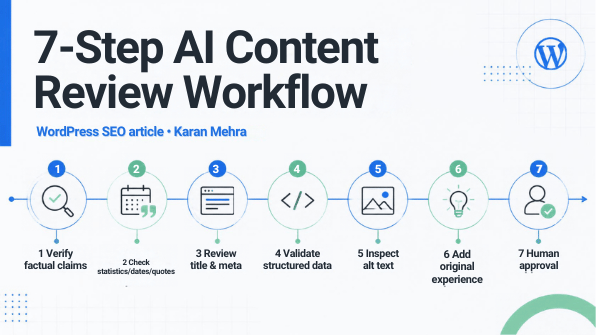
1. Verify factual claims against primary sources
Any statement involving a date, number, policy, product capability, quotation or named organisation should be checked.
For SEO news, I prefer the original Google, Microsoft, OpenAI or platform documentation wherever possible. Secondary coverage is useful for interpretation. Primary documentation should establish what actually happened.
2. Check statistics, dates and quotations separately
These are some of the easiest details for generative AI to get wrong. Do not assume a statistic is real because it sounds believable.
Open the source. Check the number. Check when the research was conducted. Check whether the quotation actually exists.
3. Review the title and meta description
This is one of the most interesting parts of Google’s new wording.
SEO teams frequently automate metadata at scale. That is efficient, but automated metadata can exaggerate what a page actually contains.
If the page says Google updated guidance, the title should not suddenly say “Google Launches New AI Content Penalty.” That changes the meaning of the event.
Accuracy matters before CTR.
4. Validate structured data
Schema generated by AI should never be treated as automatically correct.
Confirm that the properties used are supported and that the markup represents information genuinely visible or supported on the page.
5. Inspect AI-generated alt text
Alt text is another area that is increasingly automated.
An AI system may describe objects that are not actually present in an image or add SEO keywords simply because they appeared in the prompt.
Good alt text should describe the image meaningfully. It should not become another location for keyword stuffing.
6. Add something AI could not get from the existing search results
This is where AI-assisted publishing becomes genuinely valuable.
Add your own experience. Add a client situation. Add a screenshot. Add an experiment. Add original analysis. Add an opinion you can defend.
If an article simply summarizes the same five pages the AI system has already seen, publishing it adds very little to the web.
7. Make a person responsible for the final page
The most important change I would make to an AI publishing workflow is simple: someone owns the publish button.
Not the model. Not the automation. Not the content-generation pipeline.
A person should be responsible for deciding whether the page is accurate, useful and good enough to represent the business.
What This Means for Agencies and High-Volume Publishers
The bigger your content operation becomes, the more important this gets.
When five articles are published each month, reviewing each one is straightforward. When automation allows you to create hundreds of pages, errors can scale at exactly the same speed as production.
That means the competitive advantage of AI content may increasingly come from the review system surrounding it rather than from the generation tool itself.
Every agency can access powerful AI models. Not every agency has strong editorial controls.
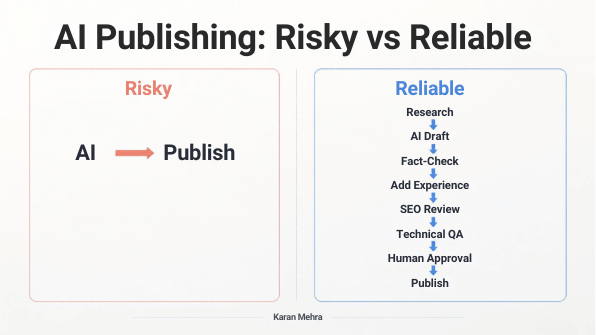
The winning workflow is therefore unlikely to be:
AI → publish
A much stronger process is:
Research → AI-assisted draft → source verification → expert contribution → SEO review → technical validation → human approval → publish
That process is slower than pressing one button. It is still dramatically faster than producing every part manually.
AI Should Accelerate Content Production, Not Replace Judgment
I use AI tools in SEO work. They are extremely useful for research, brainstorming, organizing information, extracting patterns and accelerating first drafts.
But there is an important difference between using AI to increase the speed of good work and using AI to remove the work entirely.
Google’s October update reinforces that distinction.
AI can help create the draft. The publisher is still responsible for what goes live.
That applies to the paragraph a reader sees. It also applies to the title Google may show, the schema a crawler reads and the alt text attached to an image.
If you want to strengthen the human strategy around this workflow, my SEO Services page explains how I approach technical SEO, content strategy, search intent and organic growth together rather than treating content as a standalone publishing task.
FAQs About Google’s AI Content Guidance
Does Google penalize AI-generated content?
Google has not announced a penalty simply for using AI-generated or AI-assisted content. Its published policies focus on quality, usefulness and abusive practices such as generating many low-value pages primarily to manipulate rankings.
Can AI-generated content still rank in Google?
Yes. Google’s guidance does not say AI-assisted content is automatically ineligible for ranking. The content still needs to meet Google’s Search Essentials and spam policies.
Does Google now require manual review of AI content?
Google’s updated guidance says it is “critical” to manually fact-check and review AI-generated content for accuracy and trustworthiness before publication.
Does the review apply only to the article?
No. Google specifically says the review also applies to title elements, meta descriptions, structured data and image alt text.
Should websites disclose that they use AI?
Google says giving users context about how content was created can be useful and suggests considering appropriate information about automation. The right approach will depend on the content and audience.
Final Takeaway
The biggest lesson from the latest Google AI content guidelines is not “stop using AI.”
Stop treating AI output as finished content.
Generative AI has made content production faster than at any point in SEO history. That makes editorial judgment more important, not less.
Use AI for research. Use it for structure. Use it to accelerate drafts. Then verify the facts, review the metadata, validate the schema, add something original and put a knowledgeable human between the model and the publish button.
That is the AI content workflow I would trust with a website I actually wanted to rank.


Leave a Reply