
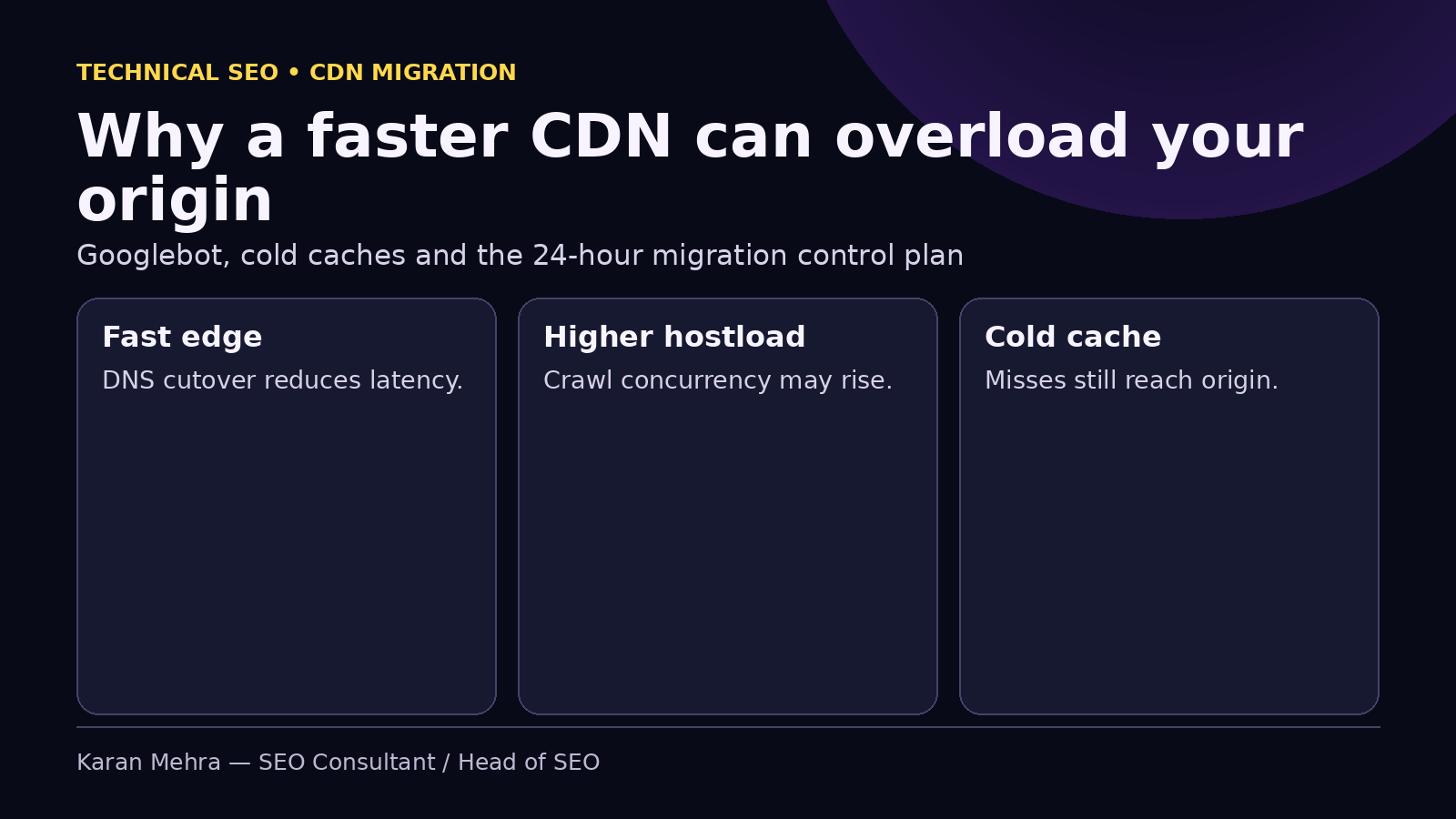
A CDN migration is normally sold as a speed and resilience upgrade. The awkward part arrives during cutover: the edge becomes fast before its caches become warm. Google’s 11 November 2026 guidance explains why that gap can produce an immediate crawler surge at the origin—precisely when engineering teams expect the CDN to reduce origin traffic.
This is not a ranking boost and it is not evidence that Googlebot has “gone rogue.” It is a capacity signal. Google’s crawling systems use host responsiveness to estimate how many simultaneous connections a site can handle. When DNS begins resolving to a fast edge, latency falls and the crawl-capacity limit can rise. If the cache is still cold, many of those requests continue to the backend.
The practical answer is a controlled migration across cache policy, origin protection, bot verification, technical SEO, analytics and revenue journeys. Teams already using a Googlebot incident runbook with Retry-After should extend it to include the CDN warm-up window rather than treating the cutover as a simple DNS change.
What Google confirmed on 11 November 2026
In “Moving to a CDN without overwhelming your origin (or blocking Googlebot)”, Google describes a specific sequence. A fast, stable CDN response tells crawling systems that the host can accept more work. Before edge caches fill, however, user and crawler requests can still be fetched from the origin. The apparent capacity increase and the cache-miss load arrive at the same time.
- Crawl capacity can rise: lower connection time and stable responses are interpreted as improved host health.
- Crawl demand still matters: Google will not necessarily fetch more URLs if there is no demand, but large or frequently updated sites often have it.
- The limit is hostname-specific: a static-assets hostname and the main application hostname can have separate crawl budgets.
- All crawlers share capacity: AdsBot or Shopping demand can compete with Googlebot for the same hostname’s available capacity.

Why a faster CDN can create more origin work
1. The edge changes the speed signal immediately
After DNS cutover, Googlebot reaches an edge location close to its fetch infrastructure. TCP, TLS and time-to-first-byte can improve even if the application behind the CDN has not changed. Google’s crawl-budget documentation says stable or improving response time can raise the crawl-capacity limit, while latency, 5xx responses and 429 responses can lower it.
2. Cache eligibility is narrower than teams expect
Static assets may cache cleanly while HTML does not. Responses with cookies, authorization headers, private directives or unsuitable cache keys may bypass the edge. Cloudflare’s cache-performance guidance separates hits from dynamic, revalidated and expired responses and recommends using appropriate TTLs and validators such as ETag or Last-Modified.
Do not assume “CDN enabled” means “origin protected.” Measure the cache-hit ratio by content class: HTML, images, JavaScript, CSS, APIs, search results, product pages and authenticated routes.
3. WAF and bot rules can turn a load event into an indexing event
A generic user-agent allowlist is unsafe; impostors can copy the Googlebot string. A strict rate rule can also block legitimate Google requests. Google recommends reverse and forward DNS checks or matching requests against its published IP ranges. The distinction mirrors the process used when auditing a new Google user-triggered fetcher at the WAF: identify the request class before granting or denying access.
If your migration joins technical SEO, cache policy and origin capacity, PRM Digital’s SEO and AI Search Optimization team can map the cutover around crawl access and business-critical journeys.
CDN migration preflight: four systems to prepare

Cache controls
- Define cache eligibility by template and response status.
- Document the cache key: hostname, path, query parameters, headers, cookies and device variants.
- Set edge TTLs, stale behavior and revalidation rules deliberately.
- Warm a representative set of priority pages and critical assets; do not blindly crawl the entire site.
Origin controls
- Establish safe requests-per-second, connection and CPU thresholds.
- Enable origin shielding, connection pooling and failover where supported.
- Separate expensive dynamic routes from cache-friendly public pages.
- Keep a tested rollback route that does not reintroduce TLS or DNS risk.
The certificate path deserves its own check. A CDN may present a trusted edge certificate while the origin connection uses another chain. The eMudhra root-removal migration guide explains why edge and origin TLS must be validated independently.
Search controls
- Preserve final status codes, canonical URLs, robots directives, hreflang and structured data.
- Keep sitemaps current and avoid introducing duplicate parameter routes.
- Verify Googlebot rather than trusting the user-agent string.
- Baseline Search Console Crawl Stats by response, file type and host.
Robots controls are not interchangeable with capacity controls. The discussion of AI training preferences in robots.txt is a useful reminder: crawler permissions, content-use preferences and emergency server signaling solve different problems.
Revenue and measurement controls
- Test lead forms, booking flows, checkout, payment returns and order confirmation.
- Check AdsBot landing-page access and dynamic-ad target behavior.
- Confirm analytics events, consent state, server-side tags and CRM receipt.
- Annotate the cutover in analytics and incident logs.
For a site-specific preflight checklist before DNS changes, WhatsApp +91 98036 18014.
A 24-hour CDN migration control plan

T−24 hours: build the baseline
Record origin request rate, TTFB, CPU, memory, database load, cacheability and error distribution. Segment access logs by verified crawler, hostname, method, path pattern, response code and bytes transferred. Export Search Console Crawl Stats and annotate current indexability for priority templates.
T−1 hour: run the production gate
Validate DNS answers, edge and origin TLS, redirect parity, canonical parity, robots.txt, sitemaps and security headers. Warm representative high-value pages. Submit one real but controlled lead, booking or transaction and confirm it reaches analytics and the CRM. A session-analytics tool can support the human journey check, but the agent-analytics guide explains why crawler and agent traffic should remain separately classified.
T+15 minutes: decide whether this is warm-up or incident
Watch cache-hit ratio, origin requests per second, TTFB, connection count, 5xx, 429, Googlebot share and revenue-path errors. A low hit ratio with healthy headroom calls for cache tuning and observation. A falling hit ratio combined with rising errors and exhausted headroom calls for origin protection or failover.
T+1, T+6 and T+24 hours: check business evidence
Compare discovery and crawl behavior with conversion evidence. A migration is not successful merely because the homepage is fast. Priority URLs must remain indexable; forms and checkout must work; analytics must record; CRM records must arrive; paid landing pages must stay reachable.
If cache and origin signals diverge during cutover, WhatsApp +91 98036 18014 with the hostname, affected template and observed status codes.
Decision framework for the first hour
| Observed signal | Interpretation | Action |
|---|---|---|
| Hit ratio low; origin healthy | Normal warm-up or cache-policy gap | Warm priority paths, review eligibility and observe 30–60 minutes |
| 5xx/429 rising; headroom falling | Origin protection incident | Reduce origin work, enable shielding or fail over |
| “Googlebot” high; IP unverified | Possible impersonation | Verify with reverse/forward DNS or published ranges |
| 403 rises for verified Googlebot | WAF false positive | Correct the rule; do not throttle with 403 |
| HTML always dynamic | Cache bypass by policy, cookies or headers | Review cache key and response directives |
Illustrative migration scenario
The figures below are illustrative, not reported by Google and not a performance promise.
An ecommerce site sends DNS to a new CDN at 10:00. Before cutover, the origin handles 12 requests per second at 45% CPU. During the first 15 minutes, the edge hit ratio is only 18%, verified Googlebot concurrency rises and the origin reaches 36 requests per second at 82% CPU.
The wrong response is to block all bots. The better sequence is:
- Confirm the requests are genuine Googlebot.
- Find which paths are missing cache and why.
- Warm the highest-value public templates.
- Enable origin shielding and reduce expensive background work.
- If service health still degrades, return 429 or 503 with a realistic Retry-After for a short emergency window.
- Restore successful responses as soon as the origin is healthy.
Google’s emergency crawl-rate guidance warns that 500, 503 or 429 responses should be temporary—generally a couple of hours or one to two days. Multiple days of errors may cause URLs to drop from the index. The objective is recovery, not a permanent crawl ceiling.
What not to do
- Do not use 403 or 404 as rate controls. They communicate access or existence problems, not temporary capacity pressure.
- Do not block Googlebot in robots.txt to save the origin. Robots rules are not an emergency load-balancing mechanism.
- Do not warm every URL. An uncontrolled warm-up can become the load test that causes the outage.
- Do not bundle unrelated changes. Keep URL, content, canonical and analytics behavior stable during infrastructure cutover.
- Do not validate only the homepage. Test representative templates and revenue paths.
The natural anchor strategy described in the internal-linking playbook applies here too: preserve meaningful discovery paths, but avoid creating new parameter combinations or low-value URL inventories during the migration.
Measurement scorecard
| Layer | Primary measures | Owner |
|---|---|---|
| CDN | Hit ratio, edge latency, cache status, bytes served | Platform / CDN |
| Origin | RPS, concurrency, TTFB, CPU, database time, 5xx/429 | Engineering / SRE |
| Search | Crawl requests, response distribution, host status, indexability | Technical SEO |
| Paid media | AdsBot reachability, landing-page errors, campaign eligibility | Paid media |
| Business | Leads, bookings, checkout completion, CRM receipt | Analytics / growth |
Technical telemetry should connect to customer outcomes. That is the same measurement principle behind evaluating AI Search visibility beyond appearances: operational signals matter only when they are tied to discoverability, usable journeys and verified outcomes.
Seven-day implementation plan
- Day 1: inventory hostnames, templates, edge rules and origin dependencies.
- Day 2: classify cache eligibility and define the cache key.
- Day 3: baseline logs, Crawl Stats and business journeys.
- Day 4: test bot verification, WAF behavior, shielding and failover.
- Day 5: rehearse the warm-up and emergency rollback.
- Day 6: cut over with a shared control room and fixed review points.
- Day 7: compare search, infrastructure and revenue evidence; document permanent fixes.
Frequently asked questions
Does moving to a CDN improve rankings?
A CDN can improve performance and resilience, but Google’s guidance does not describe an automatic ranking benefit. The migration must preserve crawl access, content, status codes, canonicals and user journeys.
Why did Googlebot traffic rise immediately after cutover?
The faster edge can make the hostname look able to accept more crawling. Before caches warm, misses still reach the origin. The combination can create a temporary backend spike.
Should we block Googlebot at the WAF?
Not as a default response. First verify the requester using Google’s documented DNS or IP-range methods. Then identify whether the problem is capacity, cache policy, crawl waste or a false-positive rule.
Can we use 429 or 503 during a CDN migration?
Yes, for a short emergency when the response accurately describes the condition. Include Retry-After when you can provide a realistic recovery interval, and restore 2xx responses promptly. Google warns against leaving these errors active for multiple days.
Which metric matters most during warm-up?
No single metric is sufficient. Read cache-hit ratio together with origin headroom, latency, 5xx/429 rate, verified crawler share and real conversion-path health.
Conclusion
The safest CDN migration is deliberately boring: representative warm-up, verified bots, observable capacity, stable SEO behavior and fixed review points. The goal is not to suppress crawling. It is to make sure the edge can absorb demand without hiding problems that still reach the origin.
For cross-functional planning across website engineering, SEO, analytics and paid landing pages, PRM Digital can structure the migration around business-critical journeys.
For an urgent second opinion on a live cutover, WhatsApp +91 98036 18014. No message is sent until you choose to contact the team.