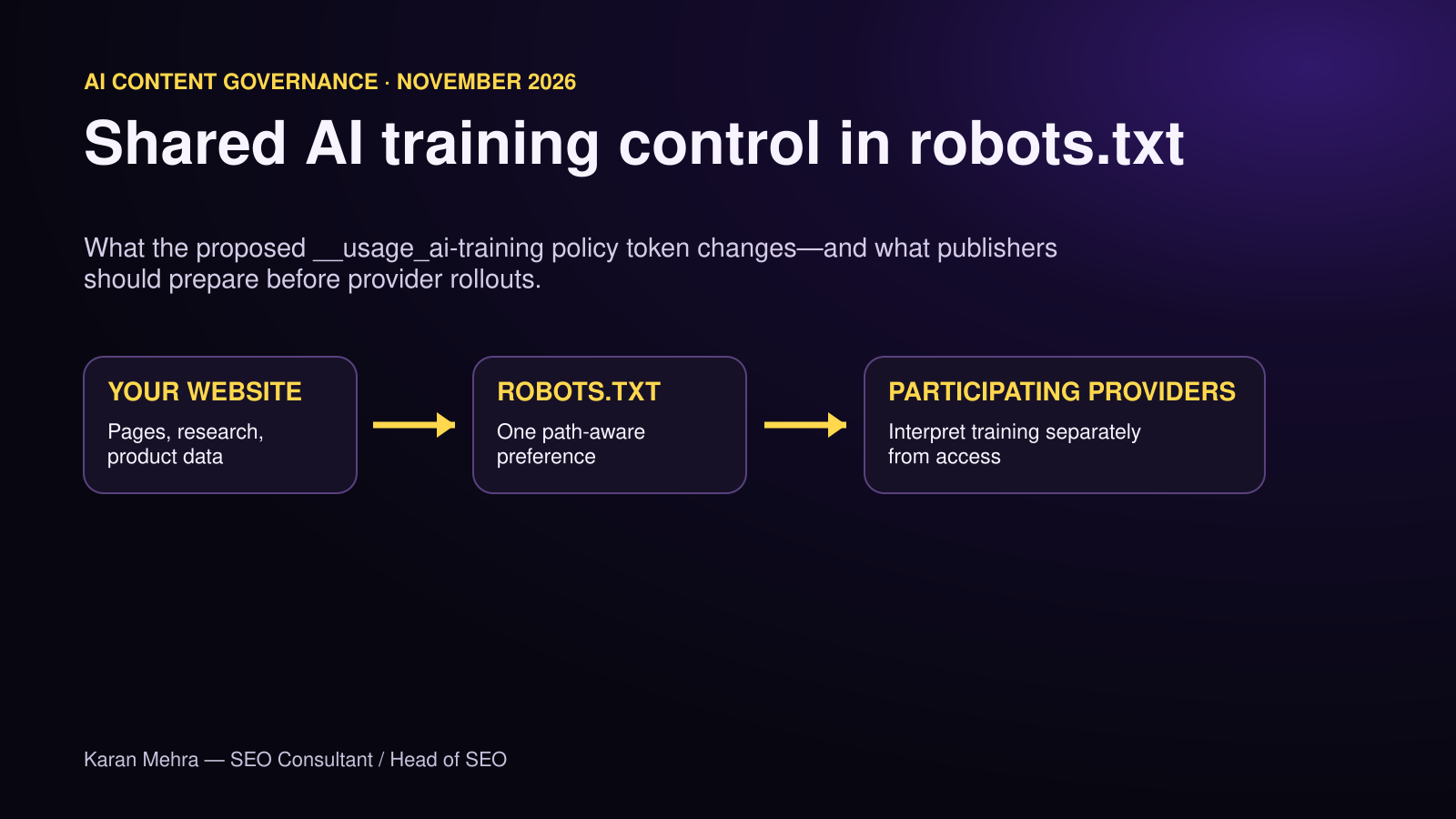
On 30 October 2026, OpenAI and Google separately announced plans to support a shared robots.txt signal for generative-AI training preferences. The proposed mechanism uses a common policy token so a website can express one path-aware preference to multiple participating providers. It is a meaningful reduction in configuration overhead—but it is not yet a universal switch, an access-control system or a replacement for existing provider-specific rules.
The change matters to more than technical SEO. It connects content strategy, publishing rights, AI-search discovery, legal review, infrastructure and analytics. Teams that already measure how their pages appear in generative experiences should treat this as the governance counterpart to measuring source visibility and business outcomes in AI Search: decide how content may be used, record the decision, implement it carefully and verify what actually happens.
What was announced—and what remains unsettled
OpenAI says it will honor a common signal in robots.txt for foundational generative-AI training and aims to implement it “in the coming months.” Its existing crawler controls remain in force. Google says it plans support in 2027; existing Google-Extended controls will continue alongside the shared mechanism.
The underlying proposal is the active IETF Internet-Draft for a machine-readable training preference signal. The draft is explicit about its current status: it is a work in progress and has no formal standing as an Internet standard. That distinction is operationally important. Website operators can prepare their policy and testing process now, but should not guess at final provider behavior or describe draft syntax as universally supported.

The proposed syntax: familiar robots.txt rules with a new purpose token
The draft does not invent a new directive. It proposes the policy token __usage_ai-training in the User-agent line, then uses normal Allow and Disallow path rules:
User-agent: __usage_ai-training
Disallow: /
Allow: /press-kit/
In the draft’s model, this expresses a preference against generative-AI training for the site except under /press-kit/. The most-specific path match still wins. An explicit Allow expresses a preference in favor of the stated use; a Disallow expresses a preference against it. If the token is absent, no preference is expressed through this mechanism.
This is not a security boundary. RFC 9309 states that robots.txt is not a substitute for valid content-security measures. Member areas, customer records, licensed datasets and private documents still require authentication, authorization and appropriate delivery controls. The operational difference is similar to the one explained in this site’s Googlebot overload and Retry-After runbook: a machine-readable instruction affects cooperative automated behavior; it does not replace infrastructure or security.
If your team needs an independent audit of crawler rules, AI-search visibility and the publishing workflow around them, PRM Digital can map the technical and commercial decisions together.
Four controls that must remain separate
1. Search crawling and indexing
Traditional crawler groups decide whether a bot may fetch specific paths for search and other documented products. Google’s crawler documentation says Google-Extended is a standalone control token and does not affect inclusion or ranking in Google Search. A blanket block against a mixed-use crawler can create a discovery trade-off that a training preference is designed to avoid.
2. Generative-AI training
The IETF draft defines AI training narrowly: using an asset to modify the learned parameters of a generative-AI model. It excludes models used exclusively for non-generative classification, ranking or scoring. That definition is more precise than the everyday phrase “used by AI.”
3. Answer-time grounding and AI input
Training and retrieval are different uses. A model may retrieve a current page to ground an answer without using that page to modify model parameters. Conversely, content used in a training corpus may not be fetched at answer time. Teams working on AI citation-gap and content-portfolio analysis should therefore avoid treating a training preference as an automatic visibility setting for every AI answer surface.
4. Access, licensing and enforcement
A stated preference depends on participating consumers honoring it. Contractual terms, licensing, bot verification, authentication and network enforcement remain separate layers. The right stack depends on the content and business model.
To review how these four layers apply to your site, message Karan Mehra on WhatsApp at +91 98036 18014.
Build the policy by content class, not with one global reaction

A useful decision starts with content inventory, not bot names. Classify paths by discovery value, intellectual-property sensitivity, customer value, regulatory exposure and the operational cost of maintaining exceptions.
- Public help centres and product specifications: high discovery value and usually low sensitivity. An allow stance may support broader discovery, subject to product and legal review.
- Original research and editorial archives: high discovery and high IP value. A path-specific stance, licensing model or delayed-access policy may be more appropriate than a site-wide answer.
- Press kits and approved brand assets: designed for reuse. An explicit allow can align the machine-readable preference with communications strategy.
- Member, client or employee content: use real access controls. Robots.txt should not be expected to keep private material private.
The same discipline applies to editorial quality. The manual fact-checking framework for AI-assisted content is relevant here because governance is not only about whether a crawler can use a page. It is also about who owns the source, when claims expire and whether the organization can defend its publishing and licensing choices.
A realistic example: a research-led B2B publisher
Consider a B2B publisher with an open help centre, a newsroom, proprietary benchmark reports and a public press kit. The team wants discovery and citations, but it does not want every research table treated as undifferentiated training material.
- SEO maps the current robots.txt, sitemaps, CDN overrides and provider-specific tokens.
- Editorial divides URLs into help, news, research and press classes.
- Legal documents the preferred use and any licensing obligations for each class.
- Infrastructure prepares a draft path policy in staging, including rollback.
- Analytics establishes baseline search referrals, AI referrals, crawl activity and conversion outcomes.
- The team waits for provider implementation notes, then tests only the documented behavior.
Illustrative figures can help during planning—say 700 help pages, 200 news articles, 80 research pages and 20 press assets—but those numbers are not performance claims. They are a classification exercise. The decision is about content purpose, not a promised traffic lift.
This avoids a common GEO mistake: optimizing the appearance of a signal without improving the underlying asset or measurement. The same principle appears in the analysis of why self-promotional listicles are weak evidence for AI visibility. Governance must be supported by useful content, explicit ownership and verifiable outcomes.
Implementation: treat robots.txt as production configuration

Step 1: create a policy register
For each content class, record the purpose, owner, sensitivity, desired training preference, crawl requirements, related licenses and review date. Document “no preference” as a deliberate state where appropriate.
Step 2: reconcile existing controls
Inventory Google-Extended and other documented provider rules. The shared token is designed to coexist with specific controls. Google says that when the shared token opts out and Google-Extended is not explicitly specified, it plans to interpret the shared signal as if Google-Extended were disallowed. Provider-specific documentation will determine precedence in practice.
Step 3: test parsing and delivery
Check UTF-8 encoding, status code, redirects, cache behavior, file size and longest-match rules. Confirm the production host serves the intended file and that a CDN, managed bot product or deployment pipeline is not overwriting it. Do not expose confidential paths merely to name them in robots.txt.
Step 4: deploy with rollback and evidence
Use version control, change approval, an owner and a rollback path. Capture the before-and-after file, validation output and reason for the decision. This is the same operational pattern used for governed AI actions in marketing operations: policy, permissions, evidence and recovery must travel with the change.
Step 5: monitor outcomes separately
Track search indexing and clicks, AI referral traffic, server logs, bot incidents and provider announcements as different evidence streams. Do not infer compliance from a traffic chart alone, and do not infer lost discovery from one AI answer screenshot.
PRM Digital brings SEO, content, analytics, web development and AI automation into one operating plan; review the agency’s full-service approach if you need implementation support across teams.
A seven-day readiness plan
- Day 1: fetch the live robots.txt and record every existing group, sitemap line and owner.
- Day 2: classify public content paths by discovery value and sensitivity.
- Day 3: separate search crawling, generative-AI training, grounding and access requirements.
- Day 4: review licensing, contracts, regulatory duties and provider-specific documentation.
- Day 5: draft—but do not prematurely deploy—the path policy and exceptions.
- Day 6: build staging, validation, change-log and rollback steps.
- Day 7: assign the implementation watchlist for OpenAI, Google and the IETF draft.
For a practical review of the inventory and decision matrix, contact Karan Mehra on WhatsApp at +91 98036 18014.
Frequently asked questions
Is the shared AI-training token an Internet standard?
No. The current document is an active individual Internet-Draft. It may change, be replaced or expire. OpenAI and Google have announced implementation intentions, but website owners should follow each provider’s final documentation.
Does opting out of AI training remove a site from Google Search?
Google says Google-Extended does not affect inclusion or ranking in Google Search. The shared training preference is designed to express a content-use choice separately from ordinary crawler rules. A separate block against Googlebot would have different consequences.
Will the token stop AI assistants from citing or linking to a page?
Do not assume that. Training, answer-time retrieval, grounding and search presentation are different uses. Provider-specific controls and documentation determine how a page can appear. Use the broader activity-and-accountability model for AI-ready marketing teams to assign owners and evidence rather than collapsing every AI use into one label.
Should small businesses change robots.txt immediately?
They should inventory and decide now, but deployment should wait for documented support and a tested configuration. A small team can adapt the same least-privilege approach used in the Gemini small-business operating model: connect or expose only what serves a defined purpose, keep human ownership visible and review outcomes.
Can robots.txt protect private or paid content?
No. Robots.txt is public and cooperative. Use authentication, authorization and appropriate application or network controls for confidential, licensed or paid material.
The strategic takeaway
The shared token is useful because it can turn a complex provider-by-provider preference into a simpler, path-aware declaration. But the durable asset is not the syntax. It is the governance process behind it: content inventory, named owners, explicit purpose, legal review, safe deployment, measurement and scheduled reassessment.
To pressure-test your policy before it reaches production, start a WhatsApp conversation with Karan Mehra at +91 98036 18014.
Sources and further reading
- OpenAI: Making it easier for websites to express AI training preferences (30 October 2026).
- Google Search Central: Supporting a shared AI training control for websites (30 October 2026).
- IETF Datatracker: Machine-Readable Training Preference Signal (Internet-Draft, updated 30 October 2026).
- Google crawler documentation: Google-Extended.
- RFC 9309: Robots Exclusion Protocol.
Editorial note: Product implementation dates and control behavior above are based on official announcements and a draft specification available on 1 November 2026. The draft may change. Operational recommendations are analysis, not claims about ranking factors or legal advice.