
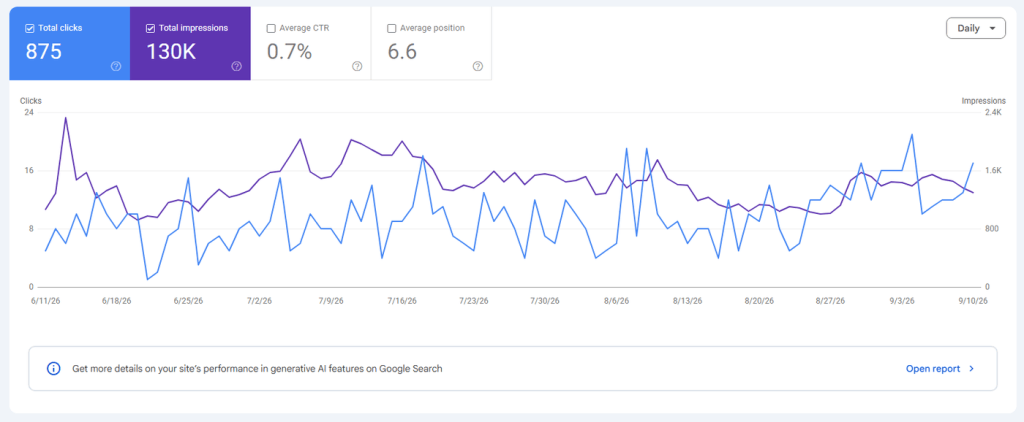
If your website traffic dropped after a Google update this year, you are standing in a long queue. The August 2026 spam update finished rolling out on 21 August. Three weeks later, business owners are still opening Search Console, seeing the same cliff in the graph, and reaching the same conclusion: Google did something to them.
Maybe it did. But the cliff on its own tells you almost nothing.
I have watched this pattern since 2018. Traffic falls, panic follows, and panic produces action. Pages get deleted. Content gets rewritten. Links get disavowed. Half the time that action is aimed at the wrong problem, and the site ends up in worse shape than the update left it.
Three completely different things can produce the graph you are looking at. Each needs a different response, and two of them need you to do nothing for several weeks. Getting the diagnosis right is the whole job, and it takes about thirty minutes.
First, confirm the drop is real
Before you touch anything on the site, rule out the possibility that nothing actually happened. It is the cheapest outcome available and you should be hoping for it.
| False alarm | How to rule it out in two minutes |
|---|---|
| Analytics tag broken or removed | Compare Google Analytics against Search Console clicks. If Search Console is flat and GA4 fell off a cliff, your tag broke, not your rankings |
| A filter or date range changed | Reset to the default view: all countries, all devices, web search only |
| Seasonality | Compare the same weeks last year, not last month. Some sectors have a genuine August dip that returns on its own |
| Server or hosting outage | Check uptime logs for 18 to 21 August. A site that was down during a crawl spike loses rankings for reasons unrelated to spam |
| Wrong property | Migrations, www to non-www, http to https. Make sure you are reading the property that actually receives the traffic |
Google sorts traffic drops by the shape of the graph before anything else. Its guide to debugging Search traffic drops includes sketches of four different curves, each pointing at a different family of causes. It is the most useful page Google publishes on this and almost nobody reads it.
While you are there, check the Google Search Status Dashboard. Crawling, indexing, ranking and serving incidents are logged publicly. Occasionally the problem is on Google’s side and it resolves without you.
Same graph, three different diseases
Now assume the drop is real.
Clients describe this to me in one sentence: my traffic dropped after the Google update. Buried in that sentence are three separate situations that look identical in a traffic graph and have nothing else in common.
| What Search Console shows | Most likely cause |
|---|---|
| Position down, impressions down, clicks down, sharp, around 18 to 21 August | August 2026 spam update |
| Gradual slide since late May, still moving | May 2026 core update still settling |
| Position flat, impressions flat or up, clicks down | AI Overviews taking the click |
| One section vanished completely, the rest untouched | Technical or indexing fault, not an update at all |
That third row is the one that catches people. Your rankings never moved. Nothing is broken. The click just stopped arriving.
Cause 1: the August 2026 spam update hit you
The tell is timing and shape. A steep drop concentrated between 18 and 21 August, global, across all languages, affecting the site at domain level rather than a handful of pages.
Spam updates are not core updates. They enforce specific violations rather than reassessing content quality broadly, which means the fix is specific too. Find the violation, remove it, wait.
Cause 2: the May 2026 core update is still settling
The May 2026 core update was the second core update of the year and it caused serious volatility, with the rollout running from 21 May to 2 June. Core updates keep moving for weeks afterwards as the system reassesses.
If your decline started in late May or early June and never really stopped, August may have had nothing to do with it. Different diagnosis, different fix, and a different timeline, because core update recovery usually waits for the next core update.
Cause 3: your rankings are fine and AI Overviews took the click
This is the fastest growing cause of a traffic drop that is not a ranking loss.
No amount of content rewriting fixes it, because the content is already good enough to rank. The work is different: structuring the page so the AI answer cites you instead of replacing you.
Google’s own guidance on AI features and your website is blunt about this: there are no special optimisations for AI Overviews or AI Mode. What decides whether you are cited is the same crawlability, structure and genuine usefulness that decides whether you rank — applied to a page that answers the question cleanly near the top.
What the August 2026 spam update actually targeted
The update rolled out on 18 August and finished on 21 August. Just over two days, global, every language. Fast rollouts are normal for spam updates; core updates take two weeks or more.
The important detail is not the speed. It is that the damage landed at domain level. Sites did not lose a section, they lost visibility across the whole property, including inside AI Overviews and in ChatGPT results where those are grounded through Google.
| Violation | What it looks like on a real site |
|---|---|
| Scaled content abuse | Hundreds or thousands of pages built from one template, each thin, with generated sections bolted on to pad length. Footprint: large URL counts, near-identical page structure. |
| Expired domain abuse | An old domain bought for its backlinks and repurposed for unrelated content. Footprint: a sudden topic shift in the domain’s history. |
| Site reputation abuse | Third-party content published on your domain to borrow your authority — coupon sections, sponsored “guest” areas. Footprint: a subfolder unrelated to the core business. |
| Link spam and manipulative outlinks | Paid or automated outbound links passing ranking credit. Footprint: outbound link patterns, not just inbound. |
The published case studies from this update are worth looking at, because the scale tells you who was really at risk. One ultra-YMYL site lost rankings across more than 200,000 queries. Another was running roughly 1.5 million indexed URLs with aggressive scaling and minimal value added per page. An affiliate site generating product pages automatically, then padding them with generated text at the bottom, dropped across 14,000 queries.
Look at those numbers and notice what they share. These were not sites that published a few AI-assisted blog posts. They were running content production at industrial scale with nothing on the page a person would have wanted. If you publish eight articles a month and you lost traffic in August, this is almost certainly not why.
Health and wellness sites were hit hardest, which is consistent with how Google treats YMYL categories like healthcare and ayurveda at every other level too.
Two myths that will waste your quarter
Two pieces of advice are circulating right now. Both are wrong, and one of them is actively dangerous because it keeps you busy while the real problem sits untouched.
Myth 1: it was an AI content penalty
It was not. There is no AI penalty and there never has been.
Google’s position has been public since 2023: it rewards high-quality content regardless of how it was produced. The line that matters sits in Google’s helpful content documentation, which says using automation to produce content “for the primary purpose of manipulating search rankings” is what breaks the spam policies.
Read that carefully, because the whole distinction lives in it.
| Not a violation | Violation |
|---|---|
| AI used to research, outline, draft or edit | Content generated at scale with no human judgement applied |
| A writer using AI to work faster on a page that helps someone | Pages produced to fill keyword slots, not to be read |
| AI-assisted content with real expertise behind it | Templated output where only the entity name changes |
| Publishing steadily because you have something to say | Publishing volume because volume used to work |
The test is purpose and value, not authorship. A human can write scaled content abuse by hand, and plenty did for years before AI made it cheap.
This myth is expensive because of where it sends you. Owners hear “AI penalty”, panic, and start stripping every AI-assisted page on the site, including pages that were ranking fine and were never part of the problem.
Myth 2: file a reconsideration request
At least one guide currently ranking for this topic tells you to submit a reconsideration request as a recovery step. Do not. It will not work, and it cannot work.
Reconsideration requests exist for manual actions only, where a human reviewer at Google has looked at your site and applied a penalty. An algorithmic demotion from a spam update has no appeal process and no form. There is nobody to write to. The system reassesses your site the next time it evaluates it, and that is the entire mechanism.
Checking which one you have takes thirty seconds: open Search Console, go to Security & Manual actions → Manual actions, and read what it says.
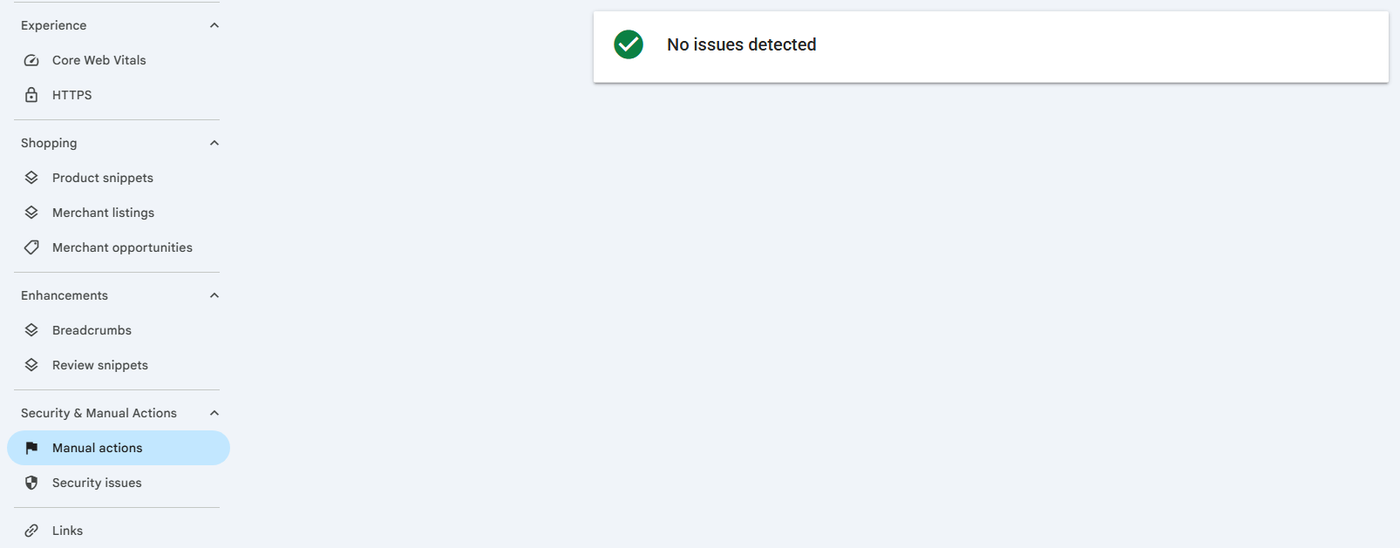
“No issues detected” means your drop is algorithmic, there is no appeal, and the recovery path is the one below. If a manual action is listed, stop reading general advice. It names the violation and tells you what to fix, which is genuinely the better problem to have.
Diagnose your own drop in 30 minutes
The order matters. I work cheapest and most decisive first, because two of these steps can end the investigation before you have spent any money. Everything below happens in Search Console. You do not need Ahrefs or SEMrush for the diagnosis, only for the fix.
Step 1: set the comparison up properly (5 minutes)
Most people get this wrong and then diagnose from bad data.
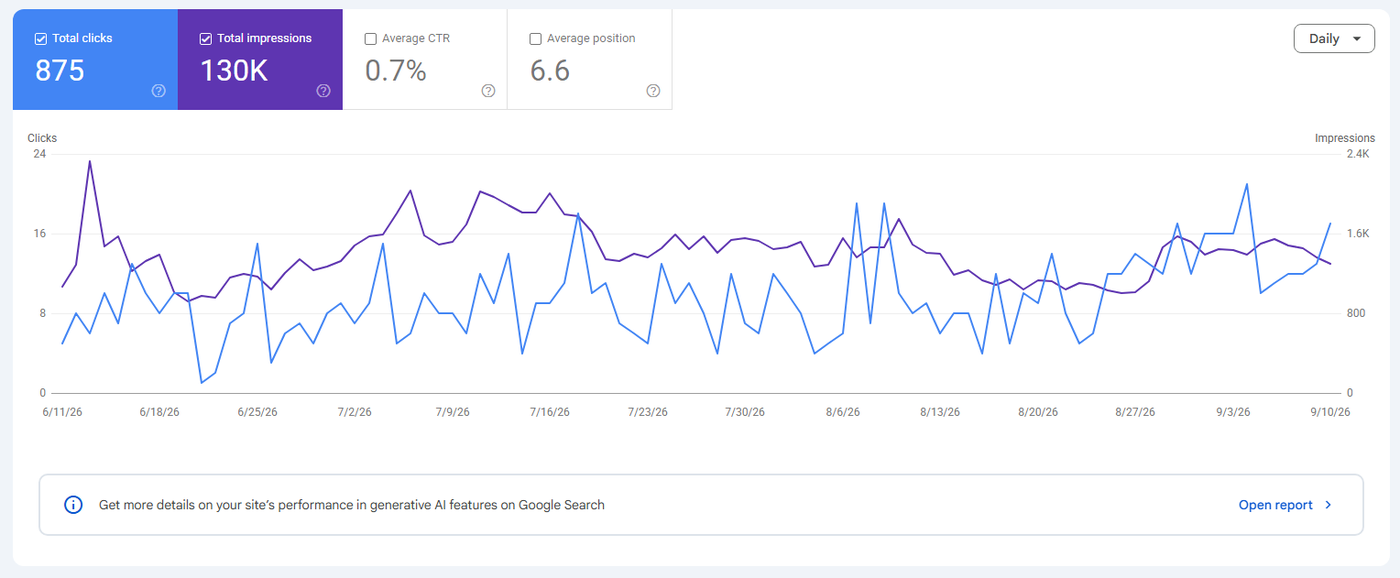
Open Performance → Search results. Set search type to Web only, because Discover and News behave differently and will muddy the picture. Then choose Compare → Custom.
Now the part people skip: exclude the rollout window itself. The update ran 18 to 21 August and those four days are noise, because rankings were actively moving. Compare the clean period before against the clean period after.
Today that means 27 July to 17 August against 22 August to 12 September. Both windows are 22 days. Equal length matters, because comparing 30 days against 21 will show you a decline that does not exist. Search Console also lags by two to three days, so ignore the tail of any window.
Step 2: separate a lost ranking from a lost click (5 minutes)
Turn on all four metrics: clicks, impressions, CTR and average position. This single comparison decides everything that follows.
| What the comparison shows | What it means |
|---|---|
| Clicks down · Impressions down · Position worse | You lost rankings. Spam or core update territory |
| Clicks down · Impressions flat or up · Position flat | You kept the ranking and lost the click. AI Overviews or another SERP feature |
| Clicks down · Impressions down · Position flat or better | You rank on fewer queries than before. Often lost coverage or de-indexing |
| Clicks flat · Impressions up · Position worse | You gained impressions on terms you rank badly for. Usually harmless |
Row two changes your whole plan. If your position held, your content is fine and rewriting it would waste a quarter.
Step 3: find the common denominator (10 minutes)
This is the step everybody mentions and nobody explains, so here is what it means when you are staring at 400 URLs.
Go to the Pages tab with the comparison still applied and export to a sheet. Sort by click difference, worst first. Take the 30 biggest losers and the 30 pages that held steady, put them side by side, and work through this list asking one question each time: what do the losers share that the survivors do not?
| Dimension | The question to ask |
|---|---|
| Page type | Are the losers all one template: category, location or product pages? |
| Folder | Do they sit in one subfolder while the rest of the site held? |
| How they were made | Were the losers produced in bulk from a template or a data feed? |
| Depth | Do the losers say less per page than the survivors? |
| Intent | Are you losing informational pages while commercial pages hold, or the reverse? |
| Authorship | Do the survivors have a named author and the losers do not? |
| Age | Were the losers all published in one burst? |
Usually one row lights up and the rest do not. That row is your answer.
If nothing lights up, that is a result too. Losses spread evenly across page types, folders and templates with no pattern at all is not what a spam update looks like. Spam updates hit a footprint. Look at the May core update instead, or at Step 5.
Step 4: read the queries, not just the pages (5 minutes)
Switch to the Queries tab with the same comparison. Did you lose your head terms, or the long tail underneath them?
Losing thousands of low-volume informational queries while your money terms hold is the signature of AI Overviews absorbing the questions. Losing your commercial head terms while informational traffic is untouched is the opposite problem, and far more urgent.
Step 5: rule out the boring explanations (5 minutes)
Before you accept “algorithm update” as the answer, spend five minutes on the explanations that are not an algorithm at all.
- Run URL Inspection on ten of your biggest losers. Check they are indexed, that the canonical is what you expect, and when Google last crawled them. A page that quietly fell out of the index did not get penalised, it got broken.
- Check the Manual actions report, as above. Thirty seconds, and it changes everything if it is not clean.
- Actually look at the search results. Open your three most important queries in an incognito window. Sometimes the honest answer is that a competitor published something better and Google agreed.
That third one is unglamorous and it is the real cause more often than anyone wants to admit. Google’s own walkthrough of analysing traffic drops puts competitive change on the same footing as everything else, and so should you.
What your diagnosis means, and how long it takes
One table, because this is where most guides send you off in six directions at once.
| Your diagnosis | What to do, and how long it takes |
|---|---|
| A footprint of templated or bulk-built pages | Fix or remove that cluster and stop publishing into it. Do not touch the rest of the site. Two to six months. |
| Slow decline since late May, no footprint | Deepen expertise on your strongest pages. Do not delete anything. Often the next core update. |
| Position held, clicks fell | Restructure so AI answers cite you. Do not rewrite content that still ranks. Four to twelve weeks. |
| Pages dropped out of the index | Technical fix, then request a recrawl. Do not blame the update. Days to three weeks. |
| Manual action listed | Follow the named instructions, then file the reconsideration request. Do not follow general recovery advice. Weeks after approval. |
| No pattern, competitors improved | Out-execute them on the specific pages losing. Do not disavow links out of panic. Ongoing. |
Thirty minutes of this is worth more than three months of guessing, and I would rather you did it yourself than paid anyone, me included, to read your own dashboard back to you.
If you reach the end of Step 5 and still cannot tell which row you are in, that is a fair point to bring someone in. Send me the site and what you found and I will tell you which one you are looking at — that read is free. If it turns out to be technical rather than content, a technical audit is where it gets fixed properly.
What recovery actually looks like
Two hard truths sit behind that timeline column.
Recovery is rarely full. Sites that clean up a genuine spam footprint usually return to a fraction of where they were, because some of that traffic was never earned in the first place.
Doing more work does not speed it up. Publishing forty new articles while you wait does not accelerate reassessment. It is the most common panic response and it can deepen the hole, particularly if the new pages resemble the old ones.
What I would do in your first 30 days
If a client came to me next week with an August drop, this is the order.
Week 1 — diagnose and stop the bleeding. Run the five steps above, then stop publishing into whichever cluster is losing. Adding pages to a footprint Google has already judged is throwing good effort after bad.
Week 2 — fix the footprint, do not carpet-bomb. Deal only with the pattern you found. Consolidate near-duplicates into one page worth reading. Remove pages that exist for a keyword and serve nobody. Rebuild the ones with a real audience so they say something the ranking pages do not. Google’s spam policies define the standard you are clearing, so read them once rather than guessing.
Week 3 — strengthen what survived. The pages that held through the update are your most valuable asset and almost everyone ignores them. Google already rates them. Deepen them, link to them internally from the rebuilt pages, and let them carry the site while the rest recovers.
Week 4 — measure, submit, document. Request a recrawl of the pages you changed. Screenshot your Search Console baseline and date it. In three months you will want proof of what changed and when, and memory is not proof.
Then wait. That is genuinely the fifth step, and it is the hardest one to bill for.
When it is not a Google update at all
Not every drop in August was caused by the August update. These are the ones I see most.
- A suspended Google Business Profile. For a local business this looks like a catastrophic traffic drop because it is one. The listing vanishes from Maps and local search overnight, and it has nothing to do with any algorithm. I wrote up how I recovered a client’s suspended listing end to end.
- A migration or redesign. New URLs, missing redirects, a noindex left on from staging. Check what your developer shipped in the weeks before the drop.
- Lost backlinks. A site that linked to you went down, got redesigned, or pruned its outbound links.
- A competitor got better. Unfashionable, and frequently true.
Frequently asked questions
Was the August 2026 spam update an AI content penalty?
No, and there is no such thing as an AI penalty. Google does not rank content down for being AI-assisted; it ranks down content produced at scale with no value added, whoever or whatever produced it.
The sites that were hit were running industrial-scale page generation. Sites publishing a handful of genuinely useful AI-assisted articles a month were not affected by this.
How long does it take to recover from a Google spam update?
Two to six months in most cases, and only once the underlying violation is genuinely fixed. There is no appeal and no way to accelerate it. Anyone quoting you a fixed recovery date is guessing.
What is the difference between a core update and a spam update?
A core update reassesses how well content serves searchers across the board. A spam update enforces specific policy violations. Core updates roll out over two weeks or more; spam updates often finish in days. They need different fixes, which is why misdiagnosis is so expensive.
Should I delete pages that lost traffic?
Not as a first move. Deletion is right for pages that exist only to target a keyword and help nobody. If a page has a real audience, improve it or merge it into a stronger one. Mass deletion after an update destroys recoverable assets more often than it helps.
Can traffic come back on its own?
Sometimes. Rankings often wobble for two to three weeks after a rollout finishes and partially settle back. That is why I tell clients not to make irreversible decisions inside the first fortnight.
Search Console shows no manual action. What does that mean?
It means no human reviewer has penalised your site, so whatever happened was algorithmic. There is nothing to appeal and nobody to contact. Your route back is fixing the underlying cause and waiting for reassessment.
The short version
If your website traffic dropped after a Google update, the most valuable thirty minutes you will spend is not on a recovery checklist. It is on working out which of three completely different things happened to you: a spam update footprint, a core update reassessment, or an AI Overview quietly taking a click you still rank for.
Fix the wrong one and you will spend a quarter making a healthy site worse. That is not hypothetical. It is the most common self-inflicted SEO injury I see.
Work through the five diagnostic steps on your own dashboard first. If you get to the end and still cannot tell which bucket you are in, send me the site and what you found. You will get an honest read on what actually hit you and what I would fix first, within 24 hours and at no cost.


Leave a Reply